

Article Summary
- A Bridge Trust® is a dual-structure trust that uses U.S. grantor-trust law for tax compliance and Cook Islands law for asset protection.
- You remain fully transparent to the IRS. All income is reportable. There is no tax shelter or secrecy component.
- Creditor protection comes from jurisdiction, not hiding assets. U.S. judgments are not automatically enforceable under the Cook Islands statute.
- Timing and control determine strength. Planning must occur before claims arise, with genuine fiduciary separation.
- When structured properly, it is disciplined legal planning and not aggressive.
If you have spent years building enterprise value, you do not evaluate asset protection casually. You don’t ask, “Does this sound strong?” Rather, you ask “Will this survive judicial scrutiny?”
That distinction matters.
Courts do not invalidate planning simply because it protects assets. They invalidate structures that are poorly timed, loosely documented, or dependent on aggressive interpretations rather than statutory authority. Many asset protection strategies fail for those reasons, not because protection itself is improper, but because the structure cannot withstand legal examination.
As a business owner, your exposure grows with your success. Personal guarantees, partnership disputes, contract litigation, and economic volatility create real risk. When those risks materialize, the quality of the legal architecture determines the outcome.
A Bridge Trust® is created with that reality in mind. Its purpose is not concealment. It does not rely on secrecy, tax avoidance, or informal arrangements. Instead, it is built on clearly codified U.S. grantor trust law for tax compliance and established Cook Islands statutory law for creditor protection.
What a Bridge Trust® Actually Is
A Bridge Trust® is a dual-jurisdiction structure. It is intentionally designed to operate within two separate legal systems at the same time:
- U.S. federal tax law controls taxation and reporting.
- The Cook Islands trust law controls creditor protection and enforcement.
These systems do not overlap, but instead serve different purposes.
Your tax obligations remain fully governed by the United States. The Cook Islands statute governs your asset protection framework. That separation is what makes Bridge Trust® asset protection structurally different from domestic planning alone. This is a coordinated structure using existing law in both jurisdictions.
The U.S. Legal Foundation: Grantor Trust Law
From a U.S. tax standpoint, a Bridge Trust® is treated as a grantor trust. This classification is not creative. It is clearly codified under:
- IRC §§ 671–677 (grantor treated as owner)
- IRC § 7701 (entity classification)
- Treasury Regulations §§ 1.671-1(b), 1.671-4(b)(2)
Here is what that means for you:
- All trust income is reported directly on your personal tax return
- There is no separate trust-level income tax
- There is no tax deferral strategy built into the structure
- There is no IRS concealment or secrecy
This transparency is critical. Courts are skeptical of structures that attempt to hide assets or avoid taxation. A properly structured Offshore Asset Protection Trust, like a Bridge Trust®, does neither. It keeps you fully compliant with U.S. reporting rules while relocating enforcement authority to a different jurisdiction.
That distinction, transparency for tax purposes, separation for enforcement purposes, is the legal foundation of the structure.
The Offshore Legal Foundation: Cook Islands Statutory Law
The strength of the Cook Islands’ Offshore Asset Protection Trust planning does not come from clever drafting. It comes from statute.
A Bridge Trust® is formed under the Cook Islands International Trusts Act, as amended through 2023–2025. That statute materially alters a creditor’s position.
Here is how:
-
- No Automatic Recognition of U.S. Judgments: A U.S. judgment does not automatically apply in the Cook Islands. A creditor must start a new legal action there.
- Criminal-Level Burden of Proof: Fraud must be proven beyond a reasonable doubt. That is a far higher burden than the typical U.S. civil “preponderance of evidence” standard.
- Strict Limitation Periods: One year if the creditor’s claim existed at the time of transfer, and two years if it did not. If the statutory window closes, the claim is barred.
- Insolvency Requirement: The creditor must prove the transfer rendered you insolvent at the time it was made.
- Duress Protections: Trustees are prohibited from complying with foreign coercion or repatriation orders.
- Bond and Fee-Shifting Rules: Creditors must post substantial bonds and may be required to pay legal fees if unsuccessful.
These protections are written into law and are statutory safeguards that define how enforcement is carried out. This is what gives Bridge Trust® asset protection its structural weight.
Why Properly Structured Offshore Trusts Withstand Court Scrutiny
You may hear critics ask, “If this works, why don’t we see more cases proving it?” The answer is simple: courts apply statutes. They do not override foreign law simply because they disagree with it. When offshore trusts fail, it is usually due to:
- Retained settlor control
- Fraudulent timing (transfers made after claims arise)
- Sham documentation
- Lack of real fiduciary separation
When those issues are absent, courts recognize their jurisdictional limits. Several U.S. cases illustrate this principle:
- FTC v. Affordable Media: Emphasized the role of independent trustees.
- SEC v. Solow: Addressed the inability to repatriate assets when control was absent.
- United States v. Grant: Examined offshore trust enforcement limits.
- Reichers v. Reichers: Reinforced legitimate family-protection purposes.
Since the 1980s, no properly structured Cook Islands trust has been penetrated by a foreign creditor under compliant conditions. That history is not accidental. It reflects statutory design and disciplined implementation.
Why Human Oversight Matters More Than Automatic Triggers
A Bridge Trust® does not rely on automatic offshore triggers. Automatic provisions can look manipulative in court. Instead, the structure relies on human oversight through a licensed Trust Protector. When a legitimate legal threat arises:
- The Trust Protector evaluates the situation
- A formal Declaration of Duress is issued
- You acknowledge the transition
- Control shifts to the Cook Islands trustee
This preserves the grantor-trust tax classification, fiduciary legitimacy, and court credibility.
Automation invites suspicion. Structured human judgment strengthens defensibility. This is one reason a properly implemented Offshore Asset )rotection trust is more resilient than reactive planning done during litigation.
The Reporting Obligations Behind a Bridge Trust®
A Bridge Trust® is not designed to be hidden. If offshore provisions activate, you must comply with:
- IRS Form 3520
- IRS Form 3520-A
- FBAR (FinCEN Form 114)
- FATCA disclosures, when applicable
All income remains taxable to you. Protection comes from jurisdictional law, not from secrecy or concealment. If you are unwilling to maintain compliance, this structure is not appropriate.
What Business Owners Must Understand Before Implementing a Bridge Trust®
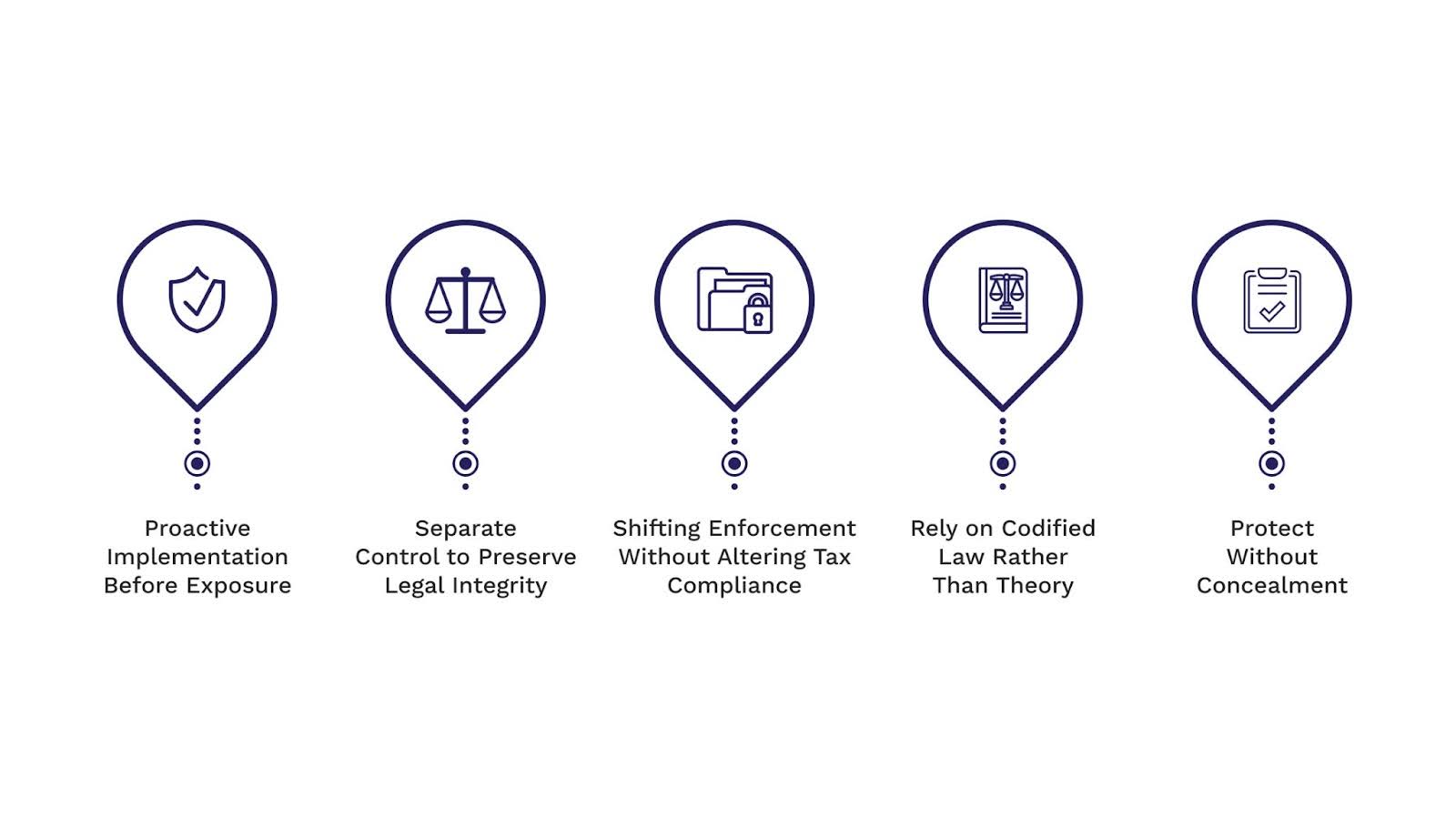
- Proactive Implementation Before Exposure
If you are serious about protecting what you build, timing is everything. A Bridge Trust® must be established before a claim is foreseeable. Courts closely examine when transfers were made and whether litigation was already anticipated.
Planning early strengthens credibility and reduces the risk of a fraudulent transfer challenge. Proper timing is one of the foundations of effective Bridge Trust® asset protection.
- Separate Control to Preserve Legal Integrity
Courts look beyond paperwork. They examine who truly controls the assets. A properly structured Cook Islands Offshore Asset Protection Trust creates genuine fiduciary separation, especially when duress provisions activate, and independent trustees assume authority. Retained control weakens protection. Structured separation strengthens it.
- Shifting Enforcement Without Altering Tax Compliance
A Bridge Trust® does not change your tax obligations. You remain fully compliant under U.S. grantor trust rules. What changes is where enforcement occurs. A properly formed Offshore Asset Protection Trust shifts creditor disputes into the Cook Islands, where foreign judgments are not automatically recognized, and statutory standards apply. Jurisdictional separation is the core strategic advantage.
- Rely on Codified Law Rather Than Theory
Asset protection must rest on legislation, not promises. A Bridge Trust® relies on U.S. tax statutes for compliance and on the Cook Islands International Trusts Act for creditor protection. Courts apply statutes. When your planning is grounded in written law, it carries weight.
- Protect Without Concealment
A Bridge Trust® is transparent for tax purposes. If an event of duress occurs (such as a lawsuit), there are required filings such as Forms 3520, 3520-A, and FBAR reporting. The structure does not hide income. Protection comes from jurisdictional law, not secrecy. Full compliance preserves long-term defensibility.
Build a Protection Strategy That Evolves With Your Business

If you are building meaningful enterprise value and thinking beyond documents toward long-term protection, this is where coordinated planning matters.
Dahl Law Group’s Strategic Planning Counsel for Business Owners™ is an all-in-one legal and tax solution designed for owners who want estate and exit planning, business planning, asset protection, business and tax law, probate and trust administration, and full tax preparation, filing, and strategy working together, not in silos.
The goal is to protect the owner, protect the business, and preserve what you’ve built through every stage of growth and transition.
Helping business owners through the formation, growth, and succession stages of their business.
Frequently Asked Questions
- Is a Bridge Trust® legal under U.S. law?
Yes. It relies on codified grantor-trust statutes and full tax reporting.
- Does it hide assets from the IRS?
No. All income and required disclosures remain reportable.
- Why the Cook Islands?
Its trust statute expressly rejects foreign judgments and imposes heavy burdens on creditors, and the statute of limitations to file a claim in the Cook Islands is much less than in the U.S.
- Can courts unwind it?
Courts apply statutes. When timing, control, and documentation are proper, enforcement power stops at the border.
- Is this only for litigation situations?
No. Proper planning requires implementation before claims arise.
- Does this replace estate planning?
No. It integrates with estate, tax, and succession planning rather than replacing them.

Dahl Law Group
Latest posts by Dahl Law Group (see all)
- Understand Property Tax Reassessment Exclusions Under Proposition 19 - April 10, 2026