

Executive Summary
- IRC 7216 and Treas. Reg. §301.7216-3 strictly limits when and how tax return information may be disclosed or used.
- CPA firms hiring non-employee or offshore preparers must obtain compliant, standalone taxpayer consents using mandatory language.
- Failures can trigger criminal and civil penalties, making consent structure a core risk-management issue.
If you are scaling your CPA firm, you are likely handling more returns with tighter deadlines and limited internal staff. Using independent contractors or offshore preparers can help you manage this demand efficiently.
But before you share any taxpayer information, you need to address one critical legal requirement: obtaining proper taxpayer consent under 26 CFR §301.7216-3.
This is not a procedural formality. It directly determines whether you are legally allowed to disclose or use client tax return information. Many firms assume their engagement letter or general privacy policy is enough. In reality, this regulation requires specific, standalone consent that meets strict legal standards.
If you share taxpayer information with non-employees or offshore teams without compliant consent, you expose yourself to criminal penalties under section 7216, civil fines, and personal liability. Even unintentional mistakes, such as improper consent formats or missing disclosures, can result in compliance violations.
As your firm grows and relies more on external preparation support, your consent process becomes a critical part of your risk protection. Getting this structure right protects your clients, your operations, and your ability to scale safely.
What Section 7216 Actually Prohibits?
Under section 7216, it is a criminal offense for a tax return preparer to knowingly or recklessly:
- Disclose tax return information without proper authorization
- Use tax return information for purposes other than preparing the return.
This applies to any individual or firm involved in tax preparation. The definition of “tax return information” is broad. It includes:
- Names, addresses, and Social Security numbers
- Income details, financial records, and filing status
- Any information collected to prepare a tax return
If you disclose this information improperly, even to another preparer, you may violate Internal Revenue Code section 7216.
How 26 CFR §301.7216-3 Allows Lawful Disclosure?
26 CFR §301.7216-3 provides the legal pathway for lawful disclosure or use of taxpayer information. You must obtain taxpayer consent that meets strict requirements. Your consent must be:
- Written and clearly documented
- Knowing and voluntary
- Specific to the exact disclosure or use
- Separate from engagement letters or other agreements
- Presented using the required format and language
If your consent is bundled, unclear, or incomplete, it is invalid. Invalid consent is treated the same as no consent.
Why Hiring Non-Employees Changes Your Compliance Obligations?
When you use employees within your firm, information sharing may fall within permitted internal preparation activities. But when you use non-employees, your obligations change.
If you share taxpayer information with:
- Independent contractors
- Offshore preparers
- Affiliate organizations
- Third-party processing services
You must confirm whether disclosure qualifies as a permitted preparation activity under Treas. Reg. § 301.7216-2 or requires taxpayer consent under 26 CFR §301.7216-3. If consent is required, you must obtain it before disclosure occurs. You cannot fix this after the fact.
Compliance Requirements and Risks You Must Address Under 26 CFR §301.7216-3
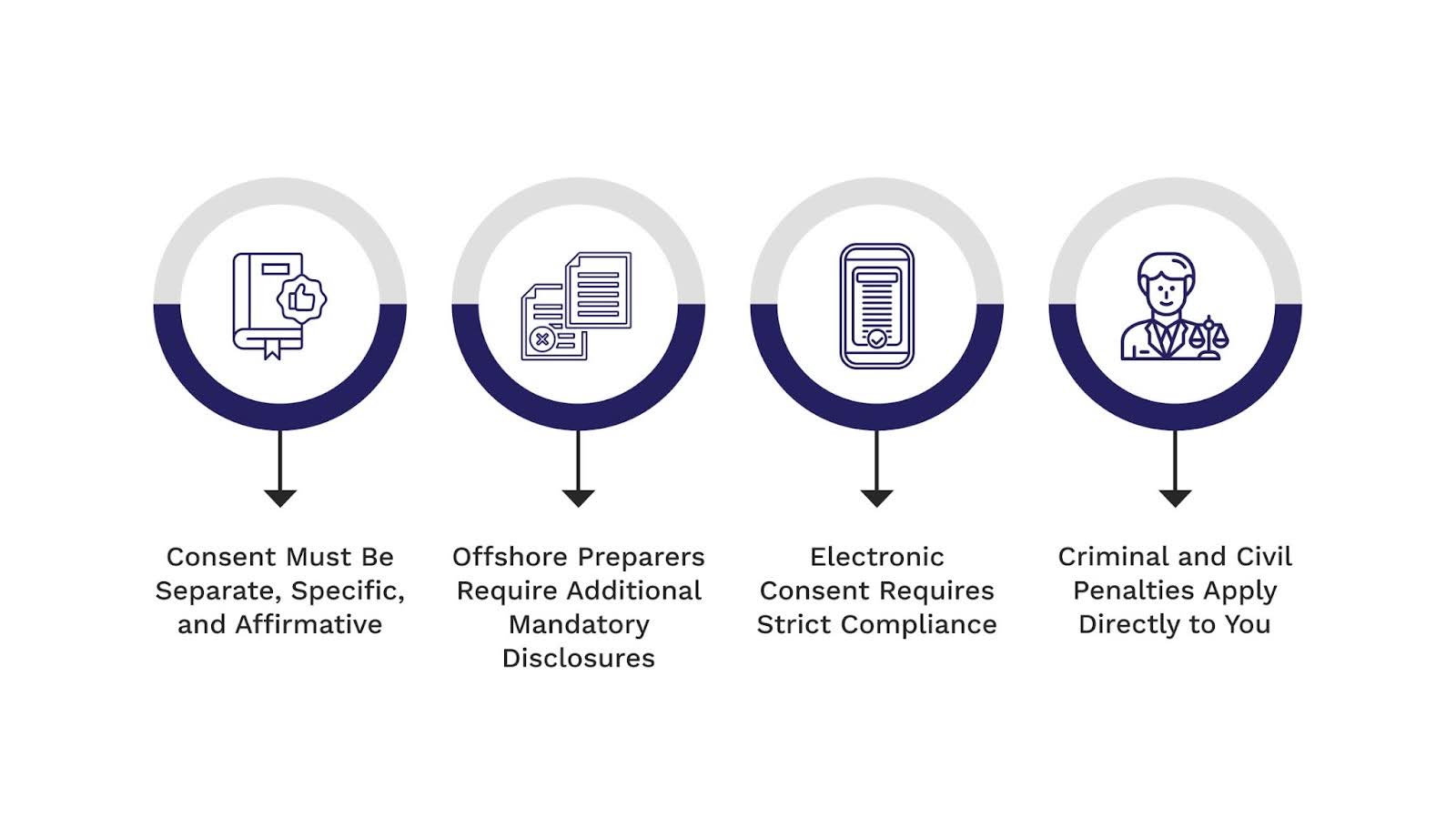
- Consent Must Be Separate, Specific, and Affirmative
One of the most common compliance failures is an improper consent structure.
Under 26 CFR §301.7216-3, your consent must meet strict structural requirements:
- Each consent must be a standalone document, absent limitations exceptions for non-individual returns
- Disclosure consent and use consent must be separate.
- Consent must relate only to one purpose.
- No opt-out language is allowed; consent must require affirmative approval.
- Consent cannot be hidden in engagement letters.
You cannot pressure clients into signing a consent form. If consent is coerced or bundled improperly, it is invalid. This means your operational workflow, not just your legal documents, must be structured correctly.
- Offshore Preparers Require Additional Mandatory Disclosures
If you disclose taxpayer information to preparers outside the United States, additional requirements apply under 26 CFR §301.7216-3. Your consent must explicitly state:
- That taxpayer information will be disclosed outside the United States
- That U.S. privacy protections may not apply overseas
- That safeguards are in place to protect taxpayer data
If Social Security numbers or other sensitive identifiers are included, your consent must include specific mandatory language required by regulation. You must also ensure both your firm and your offshore provider maintain adequate data security safeguards.
Some CPA firms assume that if the offshore preparer is a direct employee of the firm, no additional consent analysis is required. That assumption is risky.
Under Treas. Reg. § 301.7216-3(b)(4), disclosure of tax return information to a tax return preparer located outside the United States generally requires taxpayer consent, particularly when the disclosure includes a Social Security number. Employee status alone does not eliminate the offshore requirements.
If SSNs are disclosed, both the U.S. preparer and the offshore preparer must maintain an adequate data protection safeguard as defined by regulation, and the consent must include the required offshore disclosure language. Even where the offshore individual is assisting with tax preparation services, firms must evaluate whether consent is required before disclosure occurs.
Firms should never assume that labeling someone an “employee” resolves the compliance issue. Offshore workflows require deliberate regulatory review before implementation.
- Electronic Consent Requires Strict Compliance
Electronic consent is valid only if it clearly demonstrates the taxpayer’s voluntary action.
Acceptable methods include:
- Taxpayer manually typing their name
- Taxpayer entering a self-selected PIN
- Taxpayer enters a unique identifying code
Invalid methods include:
- Pre-filled consent fields
- Automatic acknowledgments
- Passive click-through consent without clear authorization
If your software improperly automates consent, your consent may be invalid under 26 CFR §301.7216-3.
- Criminal and Civil Penalties Apply Directly to You
Violating section 7216 can result in criminal penalties, including:
- Up to one year of imprisonment
- Fines up to $1,000 per violation
- Criminal prosecution and legal costs
Civil penalties may also apply under related provisions, including financial penalties for improper disclosure. These penalties apply to individual preparers, not just the firm. This makes compliance a personal risk issue, not just an organizational one.
What 26 CFR § 301.7216-2 Allows Without Taxpayer Consent
Before focusing on consent requirements, it is important to clarify that not every disclosure requires a signed consent. 26 CFR § 301.7216-2 outlines disclosures and uses that are permitted without obtaining taxpayer consent. These include, among others:
- Disclosures to employees, partners, or contractors of the tax return preparer for purposes of tax return preparation.
- Disclosures necessary to prepare, assist in preparing, or provide auxiliary services in connection with preparing a tax return.
- Disclosures required by court order or other legal process.
- Disclosures to the IRS or other federal agencies as required by law.
In practical terms, this means that if you hire a preparer, reviewer, or support staff member—whether W-2 employee or independent contractor—and they are assisting directly with tax return preparation, a separate § 301.7216-3 consent is not automatically required.
The key question is whether the disclosure is strictly for tax return preparation or auxiliary services connected to that preparation.
Once the disclosure moves beyond tax return preparation—for example, to marketing services, wealth management referrals, data analytics, or other financial services—consent under § 301.7216-3 becomes mandatory. This distinction is critical for firms expanding their service offerings or outsourcing operational functions.
What You Should Implement Immediately to Stay Compliant
If your firm uses non-employees or offshore preparers, you should implement the following protections now:
- Create Compliant, Standalone Consent Forms
Ensure each consent meets the formatting, content, and presentation requirements of 26 CFR §301.7216-3. The consent must be a separate document that clearly explains what information will be disclosed, to whom, and for what purpose.
Avoid using generic templates or combining consent with engagement letters or privacy notices. Each consent must be specific, easy to understand, and properly documented so you can demonstrate compliance if questioned.
- Separate Disclosure Consent from Use Consent
Disclosure consent allows you to share taxpayer information with another party. Use consent allows you to use the information for purposes beyond tax preparation. These authorizations serve different legal functions and must never be combined.
Keeping them separate ensures transparency and prevents confusion about how taxpayer information will be handled. This separation also protects your firm by ensuring each authorization meets regulatory standards independently.
- Add Offshore-Specific Disclosures When Applicable
If you work with offshore preparers, your consent must clearly state that taxpayer information will be disclosed outside the United States. You must include the required regulatory language explaining potential limitations of U.S. privacy protections.
This ensures taxpayers understand where their information is going and how it will be protected. It also demonstrates that your firm has taken proper steps to meet offshore disclosure obligations under 26 CFR §301.7216-3.
- Fix Your Electronic Signature Workflow
Your electronic consent process must show that the taxpayer actively and voluntarily authorized the disclosure or use of their information. This includes requiring manual input, such as entering a name, PIN, or unique identifier.
Avoid automated or passive consent mechanisms, such as pre-filled fields or default approvals. Your system must clearly show intentional taxpayer action and maintain records that prove valid authorization.
- Verify Data Protection Safeguards
You must confirm that your firm and any third-party preparers maintain appropriate data protection safeguards. This includes secure systems, controlled access, encryption, and documented security procedures.
Working with vendors who lack proper safeguards increases your legal and operational risk. Verifying security controls helps protect taxpayer information and demonstrates your firm’s commitment to compliance.
- Review Your Operational Workflow
Compliance depends on how your processes function in practice, not just what your forms say. You should review how taxpayer information is collected, stored, shared, and accessed across your systems and teams.
This includes evaluating your onboarding process, vendor relationships, and internal controls. A properly structured workflow ensures that consent is obtained correctly and consistently before any disclosure.
Why This Is a Business Protection Issue, Not Just a Compliance Task
When you scale your firm, your legal exposure scales with it. 26 CFR §301.7216-3, Treas. Reg. § 301.7216-2, and IRS Code Section 7216 create strict rules around taxpayer data disclosure. If your consent structure is weak, your growth strategy creates legal risk.
If your consent structure is strong, your growth strategy remains protected. Compliance is not about slowing your firm down. It is about protecting your ability to operate, grow, and serve clients safely.
Expand Your Operations with Confidence and Legal Protection

As your firm scales beyond W-2 employees, the risk of non-compliance under section 7216 increases, especially when working with contractors or offshore preparers. One improper consent can expose you to penalties, liability, and regulatory scrutiny.
Dahl Law Group helps CPA firms implement compliant consent structures, offshore disclosure frameworks, and legally sound workflows. We help protect your firm, your clients, and your long-term growth with clear, durable legal safeguards.
Frequently Asked Questions
- Do I need consent if the preparer is a contractor but works only on tax returns?
Yes, contractor status alone does not remove the consent requirement.
- Can consent language be included in my engagement letter?
No. Consents must be separate written documents for all individual clients, but business entity and trust clients may permit this.
- Is offshore preparation allowed with consent?
Yes, but only with additional mandatory disclosures and data security safeguards.
- Are click-through electronic consents valid?
Usually not. The taxpayer must affirmatively enter identifying information.
- Do these rules apply only to Form 1040 returns?
The revenue procedure applies specifically to Form 1040 series filers, though similar standards may apply elsewhere albeit slightly less stringent.
- What happens if my consent form is slightly wrong?
A non-compliant consent is treated as no consent at all.

Dahl Law Group
Latest posts by Dahl Law Group (see all)
- How Installment Sale Note Distributions Affect S Corps - May 1, 2026