

Article Summary
- For California business owners, estate planning directly impacts business continuity, leadership authority, and family security.
- A Revocable Living Trust is essential to avoid probate and keep the business operating without court involvement.
- Minor children are protected through a structured Kids Protection Plan that includes Temporary and Permanent Guardianship Nominations, rather than relying solely on a traditional Will.
- Powers of Attorney and Health Care Directives ensure financial and health decisions can be made quickly during incapacity.
- Community Property Agreements help clarify ownership and preserve significant federal and California tax benefits.
- Business assignment documents are critical; without them, your Trust may not control the business and the court will still be involved.
- Buy-Sell Agreements protect multi-owner businesses by defining ownership transfers and exit rules.
- The real strength of a California estate plan lies in coordination, not in individual documents.
For California business owners, estate planning goes far beyond personal assets or end-of-life decisions. Your business is likely your most valuable asset, your primary source of income, and a cornerstone of your family’s long-term financial stability. When that reality is not reflected in your estate plan, even a short disruption can have serious consequences.
Many business owners rely on incomplete or outdated plans and documents created years ago, often in isolation and never aligned with how the business actually operates today. These fragmented plans create hidden vulnerabilities that usually surface only when it’s too late to fix them.
The risk is not hypothetical. In California, lack of coordination can lead to court intervention, frozen business accounts, delayed decision-making, tax inefficiencies, and leadership uncertainty at the exact moment your business needs clarity and continuity the most.
A well-designed estate plan for a California business owner is not a single document or a checklist item. It is a coordinated system, one that aligns legal authority, ownership structure, and succession planning to keep the business running while protecting the people who depend on it.
Below are the core estate planning documents California business owners need, along with the specific roles each plays in preserving both business continuity and family security.
The Importance of Estate Planning for California Business Owners
California estate planning laws are complex, probate is public and expensive, and business assets are often tightly connected to personal finances. Without a clear, coordinated California estate plan, even a temporary incapacity can disrupt operations, delay decisions, and put your family and employees in a difficult position.
Estate planning in California is designed to answer one critical question: what happens to your assets, your business, and your decision-making authority if you cannot act for yourself?
For business owners, that question has higher stakes. Revenue, contracts, payroll, and leadership continuity all depend on having the proper legal structure in place before a crisis occurs. This is why relying on informal instructions or outdated documents creates risk. California law defaults to court involvement when authority is unclear.
That means probate proceedings, conservatorships, and rigid statutory rules stepping in where planning should have been. Having the right estate plan documents allows you to stay in control on your terms. A well-structured set of California estate planning documents helps you:
- Avoid probate and court supervision
- Ensure your business can continue operating without interruption
- Clearly define who can make financial, medical, and business decisions
- Protect your family from confusion, conflict, and unnecessary delays
- Support tax efficiency and long-term succession planning
This is not about preparing for the worst. It is about creating stability. When your estate planning documents checklist is complete and coordinated, your business is not forced to pause while legal authority is sorted out. Your family is not left guessing. And your legacy is shaped by your choices, not by default state rules.
10 Estate Planning and Succession Planning Documents Every California Business Owner Should Have
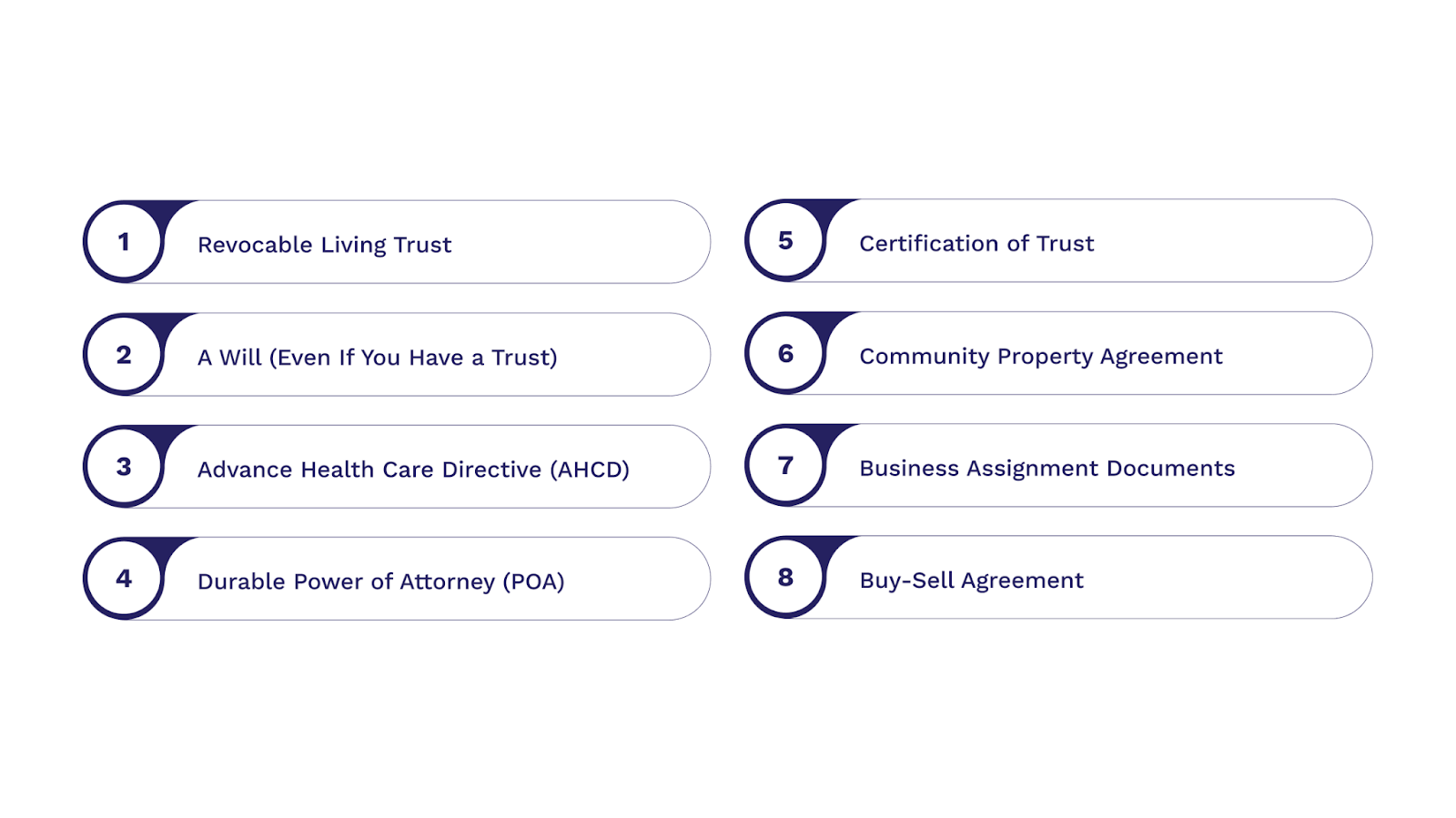
-
Revocable Living Trust
For most California business owners, a Revocable Living Trust is the core of their estate plan. Its primary role is continuity and probate avoidance, not asset protection. When your business interests are properly titled in the Trust:
- Ownership does not get stuck in probate
- A successor trustee can step in without court intervention
- Control transitions according to a documented plan
However, nearly all standard Revocable Living Trust templates are drafted with personal assets in mind, not active operating businesses.
Most generic trust documents include only brief, boilerplate language allowing a trustee to “hold or manage business interests.” That is very different from granting the detailed operational authority required to run a company. This becomes critical when a successor trustee presents the trust to:
- The company’s bank
- Payroll providers
- Merchant processors
- Vendors
- Lenders
Banks often require explicit authority in the trust document for:
- Accessing operating accounts
- Signing checks and wires
- Managing lines of credit
- Executing contracts
- Borrowing or refinancing
If those powers are not clearly drafted, financial institutions may delay access, require additional documentation, or refuse authority entirely. At best, this creates friction. At worst, it freezes operating capital at the exact moment leadership continuity is needed.
For a business generating meaningful revenue, operational interruption is not a technical inconvenience. It is a stability risk. A properly drafted business-owner trust should include:
- Detailed authority to continue business operations
- Clear signing authority language
- Authority to serve in managerial or officer roles where permitted
- Power to hire professionals and employees
- Coordination with operating agreements and buy-sell provisions
The Trust must not merely receive the business. It must be able to function with it.
If you own California real estate, a Land Trust may be used to hold title, with your Revocable Trust as the beneficial owner. The structure itself is less important than proper coordination.
But execution matters. A Trust only works if your business interests are actually transferred into it, and if the document contains sufficient powers to support real-world business continuity.
For business owners, estate planning is not a template exercise. The trust must be drafted with operational authority, contractual alignment, and succession planning in mind.
-
A Pour-Over Will Still Serves an Important Role
Even when you have a comprehensive trust-based plan, a Will remains necessary. However, its function is limited.
For California business owners, the Will typically serves as a “pour-over” document. It directs any assets not properly titled in your trust at death to be transferred into the trust through probate.
It does not serve as the primary guardianship instrument in this planning model. Guardianship planning for minor children is handled separately through a structured Kids Protection Plan, which includes:
- A Temporary Guardianship Nomination (for short-term emergencies)
- A Permanent Guardianship Nomination (for long-term court appointment)
- Supporting instructions and care documentation
This approach avoids relying solely on a Will for guardianship decisions and creates clearer protection for children if something unexpected occurs.
-
Advance Health Care Directive (AHCD)
An Advance Health Care Directive appoints someone to make medical decisions if you cannot and documents your treatment preferences.
For business owners, this document has an added layer of importance. Medical determinations often trigger incapacity clauses in Trusts and Powers of Attorney. When your health care agent, trustee, and financial agent are aligned with the right people and provisions, decisions happen faster, and disputes are less likely.
This document keeps medical decisions personal and prevents uncertainty from spilling into business operations.
-
Durable Power of Attorney (POA)
A Durable Power of Attorney allows someone to handle your personal financial matters if you’re unavailable or incapacitated. Even if your business is in a Trust, a POA is still essential for:
- Personally guaranteed business loans
- Lines of credit tied to you individually
- Personal tax filings and payments
- Household cash flows are connected to the business
Springing Powers of Attorney can cause delays. Many business owners choose immediate durability to ensure continuity, but the structure should reflect how closely your personal finances and business are connected.
-
Certification of Trust
A Certification of Trust is not a planning document; it’s an operating tool. It allows banks, title companies, and counterparties to confirm:
- The Trust exists
- Who has the authority to act without disclosing private Trust terms
This document keeps transactions moving and protects your privacy. It’s often requested at precisely the moment you don’t want delays.
-
Community Property Agreement
California is a community property state, and that directly affects your estate planning. A Community Property Agreement helps:
- Clearly define community vs. separate property
- Preserve a full step-up in basis at the first spouse’s death
- Reduce confusion and disputes later
For married business owners, this document often plays a quiet but powerful tax role, especially when business ownership or real estate is involved.
-
Business Assignment Documents
This is where many estate plans fail in practice. Creating a Trust without transferring assets into it leaves gaps. Business assignment documents formally move ownership interests, LLC memberships, shares, or partnership interests into the Trust. Without these documents:
- The Trust may not control the business
- Probate may still be required
- Succession planning breaks down
But transferring business interests into a trust is not always as simple as signing an assignment.
Transfer Restrictions May Trigger Mandatory Buy-Sell Provisions
Most operating agreements, shareholder agreements, and partnership agreements contain transfer restrictions. These provisions often state that if an owner transfers their:
- Shares
- Membership interests
- Partnership interests
—even to a revocable living trust—the transfer may:
- Trigger a right of first refusal
- Trigger a mandatory offer to sell
- Trigger a forced buyout
- Require consent of other owners
- Be treated as a “prohibited transfer”
In some agreements, an unapproved transfer can automatically convert the ownership interest into an economic interest only, stripping voting rights. In others, it may trigger a mandatory sale to the company or the remaining owners at a formula price.
Business owners are often surprised to learn that transferring ownership to their own trust can activate these clauses. The estate plan may be valid, but the operating agreement controls ownership rights.
Why This Matters for Business Owners
If you generate significant revenue and operate with co-owners, your governing documents are contractual law. A trust assignment that violates those agreements can:
- Trigger valuation disputes
- Create unintended liquidity events
- Damage partner relationships
- Undermine your succession plan
This is particularly common in closely held corporations and multi-member LLCs where agreements were drafted years earlier without coordination with estate planning.
Careful Review Before Transfer Is Essential
Before transferring any ownership interest into a trust, you must review:
- The Operating Agreement
- Shareholder Agreement
- Buy-Sell Agreement
- Partnership Agreement
- Any separate equity incentive or redemption agreements
Key questions include:
- Does a transfer to a revocable trust qualify as a permitted transfer?
- Is written consent required?
- Does the agreement distinguish between estate planning transfers and third-party sales?
- Does the transfer affect voting control?
- Are valuation provisions triggered?
In many cases, amendments to governing documents are required before assignments are executed.
Business assignment documents should never be treated as clerical paperwork. They must be coordinated with contractual ownership restrictions and your broader succession strategy.
When done properly, assignments align your trust, your ownership agreements, and your succession planning into one unified structure.
When done casually, they can destabilize the business you are trying to protect.
This step is essential to making your estate planning documents checklist actually work.
-
Buy-Sell Agreement
If you have partners or co-owners, a Buy-Sell Agreement is critical. It defines what happens when a triggering event occurs, such as death, incapacity, retirement, dispute, or exit. You are able to designate any other triggering events you may want, such as termination of employment, breach of non-compete, and other provisions. A strong Buy-Sell Agreement:
- Sets valuation rules
- Controls who can own interests
- Establishes funding mechanisms, such as life or disability buy-out insurance
- Prevents unwanted third parties from stepping in
This agreement must align with your Trust and estate plan. Conflicts between these documents are a common cause of litigation.
-
Business Succession Plan
A succession plan is not technically an estate planning document, but for business owners, it is inseparable from the estate plan.
Your estate plan answers: Who receives your assets?
Your succession plan answers: Who runs your business if you are incapacitated, retire, or pass away?
Those are different questions. A comprehensive succession plan addresses:
- Interim management if you are suddenly unavailable
- Long-term leadership transition
- Buy-sell agreements among owners
- Valuation methodology
- Funding mechanisms (insurance, installment sale, etc.)
- Tax-efficient transfer strategies
Without a succession plan, even a perfectly drafted trust can leave a business paralyzed.
For California business owners generating significant revenue, the business is often the largest and most complex asset in the estate. It cannot simply “pour over” into a trust and function automatically. Succession planning must be deliberate, documented, and coordinated with the broader estate structure.
-
Kids Protection Plan (If You Have Minor Children)
For business owners with minor children, guardianship planning requires more than naming someone in a Will. A structured Kids Protection Plan includes:
- Temporary Guardianship Nomination for short-term emergencies
- Permanent Guardianship Nomination for court appointment
- Care instructions and oversight provisions
- Clear documentation to prevent family disputes
This layered approach avoids relying solely on probate documents and ensures children are protected immediately if something unexpected happens. For parents balancing business leadership and family life, this is not optional planning. It is foundational protection.
Estate Plan vs. Succession Plan: Why Business Owners Need Both
Many business owners assume that estate planning and succession planning are interchangeable. They are not. An estate plan focuses on:
- Asset ownership
- Tax efficiency
- Probate avoidance
- Wealth transfer
A succession plan focuses on:
- Operational continuity
- Leadership transition
- Ownership transfer mechanics
- Business stability
Estate planning is about transferring value. Succession planning is about preserving value.
If your business generates $10 million in annual revenue, leadership gaps, partner disputes, or unclear transition terms can destroy enterprise value long before inheritance becomes relevant. For business owners, succession planning should not sit outside the estate plan. It must be integrated into it.
Your trust structure, buy-sell agreements, ownership percentages, and tax planning must align with your operational transition strategy. When estate and succession planning are built separately, gaps appear. When they are built together, continuity becomes intentional.
Secure Your Business Legacy with a Coordinated Plan

Each document above solves a specific problem. Together, they solve a larger one: keeping the business intact while protecting the family. Estate planning for business owners is not a one-time transaction. As revenue grows, partners change, and family circumstances evolve, the plan must evolve too.
If your estate plan has not been reviewed alongside your business structure, there may be gaps you cannot see until it is too late.
Dahl Law Group helps California business owners align estate, tax, and succession planning into a single, coordinated strategy, protecting both the owner and the business at every stage of growth.
Frequently Asked Questions
- Do I really need a Trust if I already have a Will?
Yes. A Will does not avoid probate in California. A Trust does.
- If my business is in a Trust, do I still need a Power of Attorney?
Yes. A POA handles personal financial matters that often affect the business.
- What happens if I forget to assign my business to my Trust?
That interest may still go through probate, undermining the plan.
- How often should a business owner update an estate plan?
Any time there is significant growth, restructuring, or a family change. We typically find that estate plans are updated at least every 3 years.
- Does a revocable Trust protect my business from creditors?
No. Its role is continuity and probate avoidance, not creditor protection.

Dahl Law Group
Latest posts by Dahl Law Group (see all)
- How California’s Single-Enterprise Rule Impacts Your Business - April 24, 2026