

Executive Summary
- A Bridge Trust® combines domestic administrative convenience with an offshore asset protection framework established before a legal dispute arises.
- Assets are transferred into the trust at the outset, with due diligence conducted during the initial funding process rather than after a creditor claim occurs.
- An independent Trust Protector can declare an Event of Duress, activating protective provisions already included in the Trust Agreement.
- The structure is designed to address common concerns about creditor challenges, immediate loss of control, and foreign trust administration.
- While a Bridge Trust can strengthen an asset protection strategy, its effectiveness depends on proper planning, compliance, and the circumstances of each case.
Business owners spend years building wealth, but a single lawsuit or unexpected liability can put those assets at risk. Protecting what you have built requires planning before a claim arises, when you still have time to evaluate your options.
Foreign asset protection trusts can offer additional safeguards, but they come with concerns. Some require owners to give up substantial control immediately, work with foreign trustees, and meet additional tax reporting requirements.
A Bridge Trust is designed to address some of those challenges by combining convenient domestic administration with an offshore legal framework established from the beginning.
Bridge Trust® is a registered trademark of Lodmell & Lodmell, P.C.
Critics question whether the structure provides meaningful protection. However, some of those criticisms are based on assumptions about how the trust operates rather than the provisions of the actual arrangement.
What Is a Bridge Trust?
A Bridge Trust is an asset protection structure designed to combine offshore legal protections with the convenience of domestic administration.
Unlike arrangements that require establishing a new trust or offshore trustee relationship after a legal threat develops, a Bridge Trust establishes those relationships in advance. Assets are transferred into the trust at the outset, with due diligence conducted as part of the initial funding process.
An independent Trust Protector plays an important role in the structure. If an Event of Duress occurs, the Trust Protector can declare that event under the existing Trust Agreement, activating protective provisions without creating a new trust.
For business owners, this means having an asset protection structure in place before a dispute arises, rather than trying to establish one when their options may already be limited.
Why Do Some Attorneys Criticize Bridge Trusts?
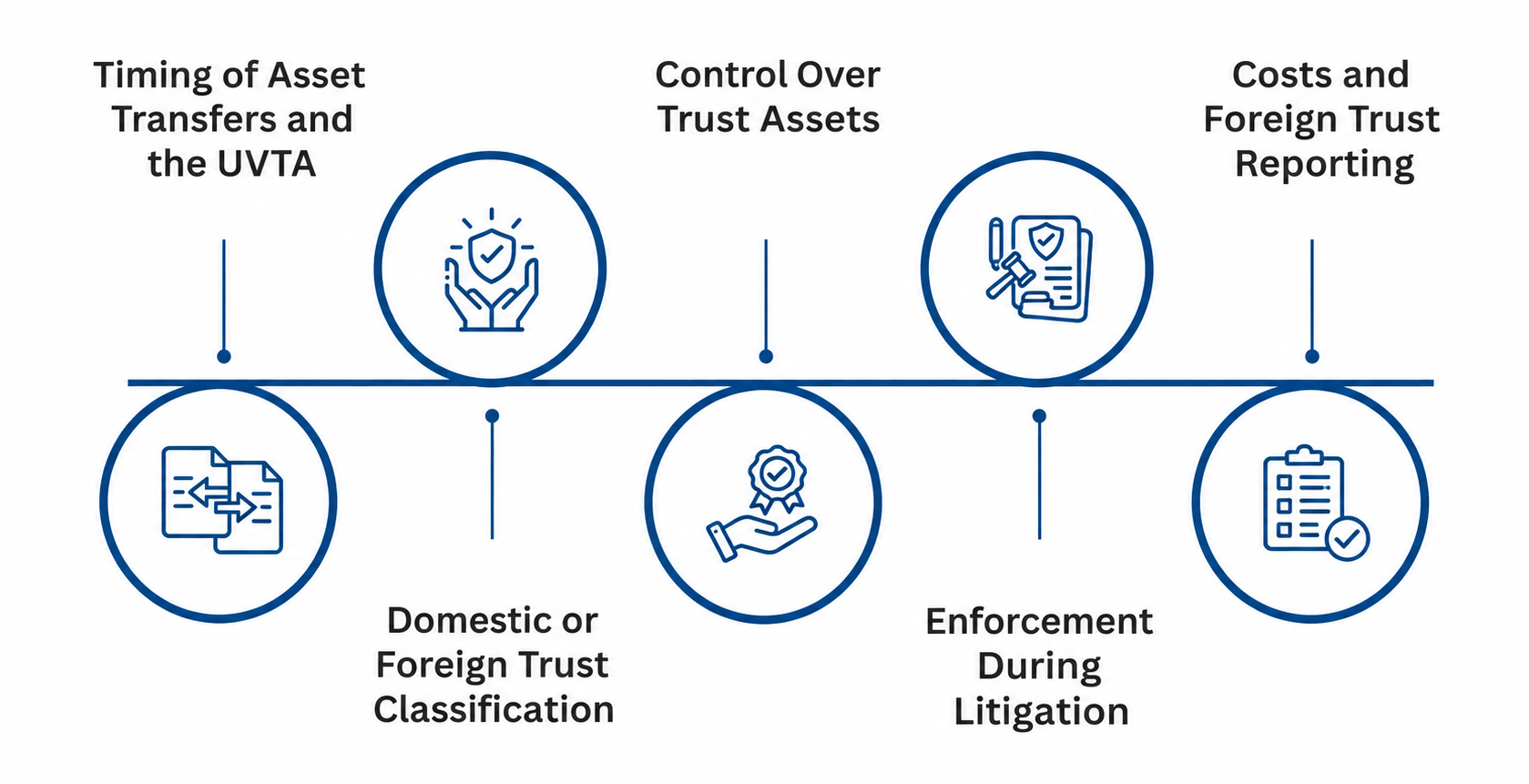
Most criticisms focus on asset transfers, trust classification, retained control, creditor enforcement, and compliance. Each raises a legitimate question, but the structure is designed to address several of these concerns.
Timing of Asset Transfers and the UVTA
One concern involves California’s Uniform Voidable Transactions Act (UVTA).
Under California Civil Code §3439.04, creditors may challenge certain transfers made with intent to hinder, delay, or defraud creditors, or under other circumstances specified by law.
The Bridge Trust addresses this concern through the timing of its funding.
Assets are transferred into the trust at the outset, not when a creditor claim occurs. Due diligence is conducted during the initial planning and funding process, including a review of existing liabilities and financial circumstances.
If an Event of Duress is later declared, the existing Trust Agreement’s protective provisions become effective. That declaration does not itself create a new trust or transfer assets into one.
Declaring an Event of Duress does not, by itself, necessarily constitute a new asset transfer. However, the legal effect depends on the Trust Agreement and any transactions or changes in asset ownership that accompany the declaration.
Early funding and due diligence do not eliminate creditor challenges under California Civil Code §3439.04. The original transfer may still be challenged under applicable law, and any later transfers must be evaluated separately. Advance planning can reduce the need for last-minute transfers, but it does not guarantee protection from creditor claims.
Domestic or Foreign Trust Classification
Another criticism assumes the Bridge Trust begins as a domestic trust and becomes foreign when a lawsuit arises.
However, a Bridge Trust’s offshore legal framework and trustee relationship are established from the outset.
Federal tax classification is a separate issue. Under IRS rules, a trust generally qualifies as domestic for federal tax purposes only if it satisfies both the U.S. court supervision and U.S. control tests.
A Bridge Trust may satisfy the U.S. court and control tests during ordinary administration, depending on its governing documents and actual operation. However, if an Event of Duress changes who controls substantial trust decisions, the trust may become foreign for federal tax purposes if the U.S. control test is no longer satisfied.
This is different from establishing an entirely new offshore trust. The offshore legal framework may already exist, while the trust’s federal tax classification can change based on how its powers are exercised. Business owners should review the potential tax consequences before establishing the arrangement.
Control Over Trust Assets
Traditional offshore trusts may require owners to transfer substantial management authority to foreign trustees immediately.
A Bridge Trust is intended to offer greater flexibility.
Certain domestic management arrangements may remain in place during ordinary circumstances. If an independent Trust Protector declares an Event of Duress, the agreement imposes protective restrictions and allows the Protector to exercise additional powers.
The owner does not control that declaration.
This separation is important because asset protection depends in part on genuine fiduciary independence. The structure is intended to provide practical administration without relying on the owner to activate protections during a legal dispute.
Enforcement During Litigation
Critics also question whether a Bridge Trust’s offshore protections can withstand creditor challenges in U.S. courts.
Unlike arrangements that depend on establishing new offshore relationships after litigation begins, a Bridge Trust has its protective framework in place from the outset. Its independent Trust Protector can activate provisions already established in the Trust Agreement.
California law also limits the protection available through self-settled trusts. Under California Probate Code §15304, a trust generally cannot shield assets from the settlor’s creditors simply by restricting distributions to the settlor. U.S. courts may also issue enforceable orders against individuals within their jurisdiction, creating potential contempt risks if those orders are not followed. Offshore provisions do not automatically eliminate these concerns.
This approach addresses concerns about making last-minute structural changes when a legal dispute arises. Advance planning and clearly defined fiduciary responsibilities may strengthen an asset protection strategy, but the outcome still depends on applicable law, court authority, and the specific circumstances.
Costs and Foreign Trust Reporting
Foreign trusts can involve additional expenses, reporting requirements, and administrative responsibilities.
If an Event of Duress causes the trust to become foreign for federal tax purposes, additional reporting obligations may arise. Depending on the trust’s ownership and transactions, these may include IRS Form 3520 and Form 3520-A. Separate FATCA or FBAR obligations may also apply when their requirements are met.
Traditional offshore administration can also involve foreign trustee fees and reduced day-to-day management flexibility.
The Bridge Trust is intended to provide a more convenient approach during ordinary circumstances. However, it does not automatically eliminate foreign reporting requirements, particularly if its tax classification or administration changes.
These obligations should be evaluated when establishing the trust.
Does That Mean a Bridge Trust Is Ineffective?
Not necessarily. A Bridge Trust is designed to establish its protective framework before a legal problem develops, which may address some common criticisms. However, its effectiveness is not automatic. California creditor protections, the enforceability of court orders, the terms of the Trust Agreement, and potential tax consequences all affect how the structure performs.
Assets are transferred into the trust at the outset, with due diligence conducted during the funding process. The offshore trustee relationship and protective provisions are also established in advance, rather than arranged after a creditor claim arises.
This approach addresses two common concerns: last-minute asset transfers and the need to give up substantial management authority to a foreign trustee immediately.
For California business owners with significant assets or potential liability exposure, a Bridge Trust can offer a practical way to strengthen an existing asset protection plan. It should be considered alongside other measures, including LLCs, insurance, and estate planning.
Learn more about asset protection for business owners in California.
Take the First Step Toward Stronger Asset Protection

A Bridge Trust is designed to establish protective arrangements before they are needed, rather than requiring business owners to make major structural changes after a claim arises.
Its value lies in advance planning, appropriate due diligence, and clearly defined fiduciary responsibilities.
At Dahl Law Group, we coordinate asset protection, business law, tax strategy, and estate planning through our Strategic Planning Counsel for Business Owners® approach.
If you are considering a Bridge Trust, we can help evaluate whether it fits your assets, business obligations, and long-term goals.
FAQs
Not automatically. A Bridge Trust’s offshore legal framework may exist from the outset. However, if an Event of Duress changes control over substantial trust decisions, the trust may become foreign for federal tax purposes if it no longer meets the U.S. control test.
Declaring an Event of Duress does not itself create a new asset transfer. The legal effect depends on the Trust Agreement and any accompanying transactions. Existing transfers may still be challenged under applicable law.
An independent Trust Protector acting under the Trust Agreement.
No. Reporting depends on the trust’s federal tax classification, ownership, financial accounts, and administration.

Dahl Law Group
Latest posts by Dahl Law Group (see all)
- When Should Business Owners Consider a Kovel Agreement? - November 9, 2026