

Article Summary:
- Certain residential property transfers to LLCs, Trusts, or partnerships must now be reported to FinCEN.
- Your existing entity-owned property is not affected unless you make a new transfer.
- You must disclose both entity details and beneficial owner information.
- Routine restructuring can trigger reporting.
- Preparation is essential to avoid delays and compliance issues.
If you own residential real estate through an LLC, partnership, or Trust, the FinCEN real estate reporting rule is now part of your transaction process. As of March 1, 2026, certain non-financed residential real estate transfers must be reported to the federal government.
This is not retroactive. It does not affect property you already own. It applies only when you transfer residential property to an entity or Trust without institutional financing.
If you plan to restructure ownership, move property into an LLC, or transfer property between entities, you must prepare for FinCEN reporting requirements before closing.
This is a disclosure requirement, not a prohibition. Your structure remains valid. Your ownership strategy remains legal. What changes is the reporting obligation tied to qualifying transfers.
For business owners who hold homes inside asset protection structures or who move property among entities as part of tax or succession planning, this rule changes how transfers must be handled.
Understanding the FinCEN Real Estate Reporting Rule
The FinCEN real estate reporting rule is part of the federal government’s broader effort to increase transparency in real estate ownership. It requires reporting of certain residential real estate transfers where the buyer is a legal entity or Trust and the transaction is completed without traditional mortgage financing.
This falls under expanded FinCEN reporting requirements, administered by the Financial Crimes Enforcement Network (FinCEN), which monitors financial activity to prevent illicit use of anonymous entities.
For you as a business owner, this means ownership transfers involving entities must now meet federal disclosure standards.
When FinCEN Reporting Is Required?
A FinCEN real estate reporting obligation is triggered when all three of the following conditions apply:
- The Property Is Residential Real Estate
This includes:
- Single-family homes
- Condominiums
- Townhomes
- Cooperative units
- Residential vacant land intended for housing
- The Transfer Is Non-Financed
This means there is no traditional mortgage from a regulated financial institution. Cash transactions and privately financed transfers typically qualify.
- The Buyer/Transferee Is An Entity Or Trust
The transferee must be:
- An LLC
- Corporation
- Partnership
- Trust
- Any other legal entity
If those three elements exist and the transaction closes on or after March 1, 2026, a Real Estate Report must be filed electronically with FinCEN. Existing entity-owned property remains unaffected unless a new transfer occurs.
What FinCEN Reporting Means for Your Entity or Trust?
If your entity acquires residential property, you must disclose both entity information and beneficial ownership information.
- Entity Information Required
You must provide:
- Legal entity name
- Business address
- Jurisdiction of formation
- EIN (Employer Identification Number)
Even single-member LLCs must be reported separately.
- Beneficial Ownership Information Required
You must disclose individuals who:
- Own 25% or more of the entity, or
- Exercise substantial control
This includes providing identifying details such as:
- Full legal name
- Address
- SSN or ITIN
This is a core component of FinCEN reporting rules. The federal government now requires visibility into who ultimately owns and controls entity-owned residential property.
Who is Responsible for Filing the FinCEN Report?
In most cases, you do not personally file the report. The responsibility usually falls on the closing professional, such as:
- Title companies
- Escrow agents
- Settlement agents
- Business, real estate, and estate planning attorneys
The parties can agree in writing who will submit the report. It generally does not fall directly on the buyer.
However, entity buyers must provide the required ownership and identification information in advance. If the documentation is incomplete, delays in closing are likely.
Common Transfers That Now Trigger FinCEN Reporting
Many routine restructuring transactions now fall under FinCEN real estate reporting requirements, including:
- Transferring your residence or investment property into your LLC
- Moving property from one LLC to another
- Placing residential property into a Trust
- Transferring property from an LLC to a partnership
- Transferring property to a newly created entity
Even if you control both entities, reporting may still apply. FinCEN focuses on the legal transferee, not whether ownership control remains the same.
What Does Not Trigger FinCEN Reporting?
It is equally important to understand when reporting is not required. FinCEN reporting generally does not apply to:
- Property you already own in an entity before March 1, 2026
- Transfers involving individual buyers
- Commercial real estate transactions
- Transfers involving traditional mortgage financing
- Passive ownership without a new transfer
This is not an ongoing reporting obligation. It applies only when qualifying transfers occur.
Why This Matters for Your Asset Protection and Estate Planning Strategy?
If you use entity structures for asset protection, tax planning, or succession planning, this rule directly affects how you manage transfers. Many business owners hold property using layered structures, such as:
- Residential property owned by an LLC
- LLC owned by a family limited partnership
- Partnership owned by a Trust
These structures remain effective and legal. However, when you transfer residential property between entities within your structure, FinCEN reporting rules may now apply. This makes documentation accuracy essential.
You must ensure that EIN records are active and correct, ownership percentages are clearly documented, Trust records are current, and beneficial ownership information is complete. Poor documentation can delay or complicate your transaction.
Practical Steps You Should Take to Prepare for FinCEN Real Estate Reporting
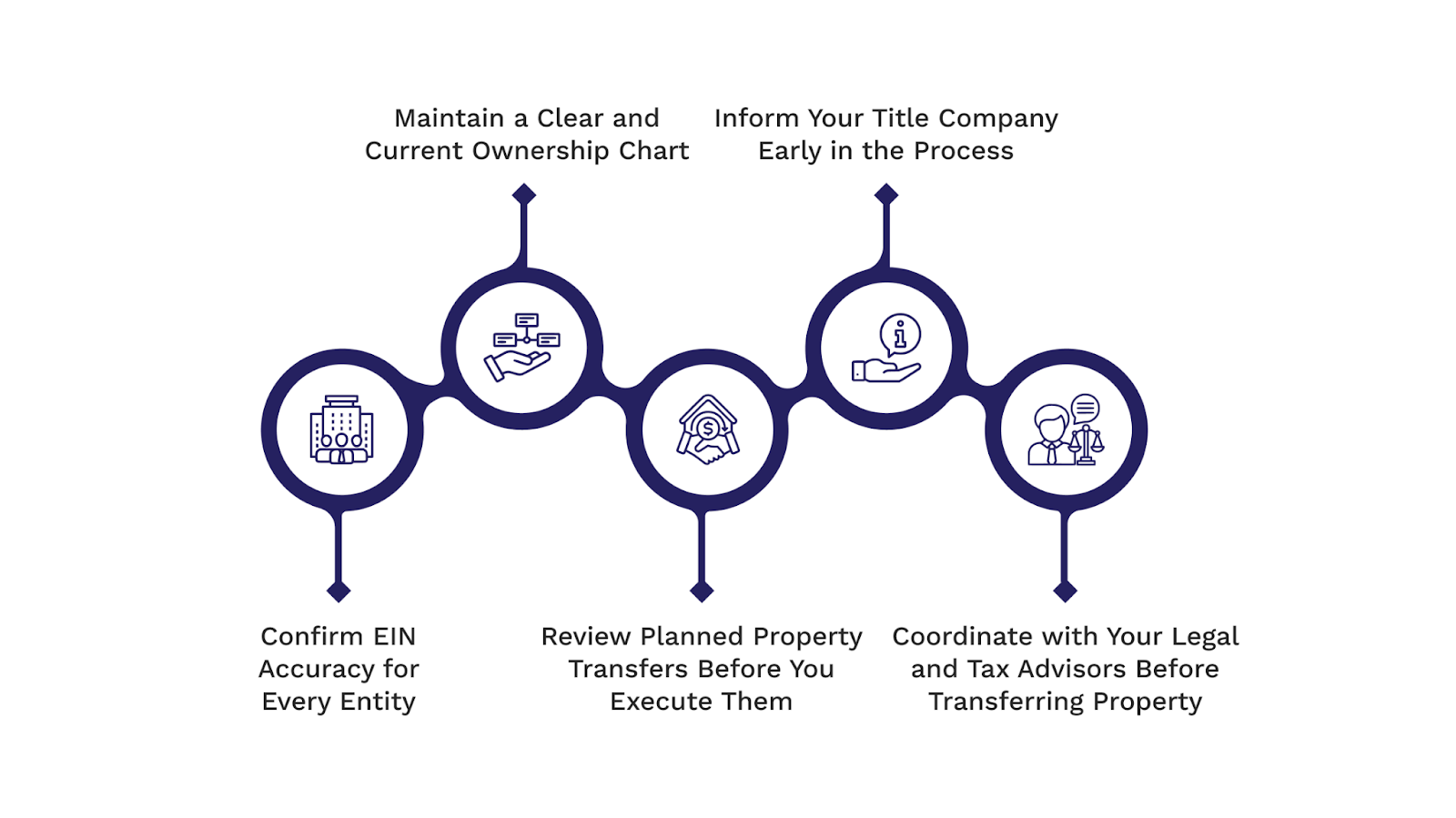
If you own residential real estate through an LLC, partnership, or Trust, preparation is now essential. The FinCEN real estate reporting rule requires accurate entity and ownership information at the time of certain transfers. If your records are incomplete or outdated, your transaction can be delayed or flagged.
Here is what you should do now and why each step matters.
- Confirm EIN Accuracy for Every Entity
Your Employer Identification Number (EIN) is a key identifier under FinCEN reporting requirements. It connects your entity to federal records and confirms its legal existence. You should verify that:
-
- Each LLC, partnership, or corporation has an assigned EIN
- The EIN matches the entity’s exact legal name
- The EIN is active and properly registered with the IRS
- Your entity has filed the required tax returns, if applicable
Even single-member LLCs must be properly identified. If your EIN records are incorrect or missing, your title company cannot complete the required FinCEN reporting. Fixing EIN issues during closing can delay the closing. Fixing them in advance keeps your transaction on schedule.
- Maintain a Clear and Current Ownership Chart
FinCEN reporting rules require disclosure of beneficial owners. This means you must know exactly who owns each entity and in what percentage. You should maintain a simple ownership chart that shows:
-
- Each entity in your ownership structure
- The individuals or entities that own each entity
- Ownership percentages for each owner
- Any Trust ownership and trustee information
This is especially important if your structure includes multiple layers, such as an LLC owned by a partnership, a partnership owned by a Trust, and multiple entities with shared ownership. If you cannot clearly show ownership, your closing professional cannot complete the required FinCEN real estate reporting.
- Review Planned Property Transfers Before You Execute Them
Many routine restructuring actions now fall under FinCEN reporting requirements. You should review transfers before signing any deeds or agreements. This includes transfers such as:
-
- Moving property into an LLC for asset protection
- Transferring property between your existing entities
- Placing residential property into a Trust
- Acquiring property through a newly formed entity
Even if you control both entities, reporting may still be required. Planning ahead prevents delays and compliance issues.
- Inform Your Title Company Early in the Process
Your title company or settlement agent is usually responsible for submitting the FinCEN report. However, they rely on you to provide accurate entity and ownership information. You should notify them early if:
-
- The buyer will be an LLC, Trust, or partnership
- The transfer involves entity restructuring
- The property is being moved within your ownership structure
Early communication allows the title company to prepare FinCEN reporting documentation, request necessary ownership information in advance and avoid last-minute complications
- Coordinate with Your Legal and Tax Advisors Before Transferring Property
Property transfers involving entities affect more than just FinCEN reporting. They can impact your legal protection, tax position, and overall ownership structure. You should review transfers with your advisors to ensure:
-
- The transfer aligns with your asset protection strategy
- Your entity structure remains properly maintained
- Your ownership records are accurate
- You meet all FinCEN reporting requirements
This is particularly important if your structure involves multiple entities or Trusts. Your advisors can help you prepare documentation in advance, reducing friction during closing.
How FinCEN Reporting Fits Into the Bigger Federal Transparency Shift
The FinCEN reporting rule reflects a larger federal effort to increase transparency around entity ownership of residential real estate. This does not eliminate the need for asset protection strategies. It does not prevent entity ownership.
It requires disclosure when qualifying transfers occur. If you use entities properly for legitimate business, estate planning, or asset protection purposes, your strategy remains fully viable.
The key change is procedural. Transfers must now include proper reporting and documentation.
What You Should Do Before Your Next Property Transfer?
If you are planning to:
- Move residential property into an LLC
- Transfer property between entities
- Acquire residential real estate through a Trust or entity
- Restructure ownership for asset protection or succession planning
You should evaluate FinCEN reporting requirements before signing any transfer documents. Early preparation protects your timeline, reduces closing delays, and ensures full compliance.
The FinCEN real estate reporting rule is now active. Every qualifying residential entity transfer must be evaluated with this requirement in mind. Being prepared ensures your ownership strategy continues to work smoothly and effectively.
Review Your Entity and Real Estate Structure with Strategic Legal Guidance

If you are planning to restructure, acquire, or reposition residential real estate inside your business or estate plan, now that the rule is active, every transfer must be evaluated before documents are signed.
As Strategic Planning Counsel for Business Owners™, Dahl Law Group integrates estate planning, asset protection, business law, tax strategy, succession planning, probate, Trust administration, and full tax preparation into a unified structure.
If residential real estate is part of your ownership strategy, this is the moment to review it deliberately before your next transfer triggers federal reporting obligations.
Frequently Asked Questions
- Do I need to file anything if my home was placed in an LLC before March 1, 2026?
No. The rule applies only to qualifying transfers that closed on or after March 1, 2026. - Does this apply if I transfer property between my own entities?
Yes, if the transfer meets the residential, non-financed, and entity-owned criteria. - Does commercial property trigger this rule?
No. The rule applies only to residential real estate as defined by FinCEN. - What if I use bank financing?
Traditional institutional mortgage financing generally removes the transaction from the reporting requirement. - Who is responsible for filing?
Usually, the title company, escrow agent, or attorney, but entity owners must provide accurate ownership information. - 6. Is this the same as beneficial ownership reporting under the Corporate Transparency Act
No. This is a separate transaction-based reporting rule specific to qualifying residential real estate transfers

Dahl Law Group
Latest posts by Dahl Law Group (see all)
- How California’s Single-Enterprise Rule Impacts Your Business - April 24, 2026