

For many business owners, overseas trips often blend work and leisure, usually focused on attending conferences, meeting clients, or exploring new markets. While the IRS allows business expense deductions for international travel, they come with strict conditions.
The trip must be primarily for business, with clear documentation proving the purpose and timeline. Understanding the rules for deducting an international business trip, especially the 7-day and 75 percent tests, can help ensure you remain compliant while maximizing legitimate deductions.
At Dahl Law Group, we help California business owners and executives confidently navigate these IRS standards, structuring travel to balance productivity and compliance.
Article Summary
- Business Purpose Required: International travel qualifies as a business expense only when the trip is primarily work-related.
- Follow IRS Time Tests: The 7-day and 75 percent rules determine how much of your travel costs are deductible.
- Keep Clear Documentation: Detailed records of meetings, dates, and expenses prove the trip’s business intent.
- Plan Strategically: Careful scheduling ensures compliance while maximizing legitimate deductions.
The General Rule for International Business Travel
According to IRS business travel deductions guidelines, travel expenses are deductible when the trip is directly related to income-generating activities. This includes airfare, lodging, ground transportation, and meals for business days.
However, when personal activities are mixed in, deductions become limited. The IRS examines the proportion of days spent on business versus leisure. The more personal days added, the higher the risk of partial disallowance.
The 7-Day Rule Explained: How Short Trips Qualify as Business Travel?
When it comes to IRS business trip rules, the 7-day rule is one of the most important tests for determining whether an international business travel expense is deductible. This rule focuses on the total length of the trip and whether it can reasonably be considered “primarily for business.”
If your trip outside the U.S. lasts seven days or fewer, the IRS generally assumes it was taken mainly for business purposes. This means you can deduct 100% of your transportation expenses, including airfare, baggage fees, and ground transfers, even if a small portion of the trip includes leisure activities. The assumption here is that such a short trip doesn’t provide enough time for significant personal recreation to outweigh the business intent.
However, the IRS is specific about how those seven days are counted:
- Travel days don’t count as personal days. The days spent flying to and from your destination are automatically treated as business days.
- Partial business days count. If you attend a meeting or perform work for part of the day, it still counts as a business day, even if you spend the rest of the day sightseeing.
- Weekends in between business activities count as business days, as long as staying over is reasonable to continue business work on the following weekday (for instance, when a Friday meeting is followed by one on Monday).
For example, you fly from Los Angeles to Paris on Monday, hold meetings Tuesday through Friday, and return on Sunday. The IRS would treat the entire trip, seven days total, as business travel, making airfare fully deductible.
The 75 Percent Rule: How to Keep Your International Business Travel Deductible
For longer international trips, the IRS applies what’s known as the 75 Percent Rule, one of the most essential IRS business trip rules to understand before you book your flight. This rule helps determine whether your international travel business expense is primarily for business or personal purposes and, therefore, how much of your trip can be deducted.
According to U.S. Code § 274(c)(2)(B), if at least 75% of your total travel days are spent on business activities, your trip is considered primarily business-related. This means your airfare and other major transportation expenses are fully deductible under IRS business travel deductions.
If your trip doesn’t meet the 75% threshold, the IRS limits your deductions. In that case, you can only claim the portion of your travel expenses directly tied to business days.
How to Calculate the 75 Percent Rule
Let’s say you’re planning a 12-day overseas trip:
- 9 days are spent in meetings, client visits, and conferences.
- Three days are for personal sightseeing.
Since 9 of 12 days (75%) are business-related, your airfare and related transportation costs are fully deductible. However, if only 6 out of 12 days are for business, that’s just 50%, meaning only half of your transportation expenses qualify for deduction.
This distinction can significantly affect your tax outcome, so tracking your business versus personal days accurately is essential.
Tips to Stay Compliant with IRS Business Travel Deductions
- Plan. Before finalizing your itinerary, ensure that at least 75% of your total travel time is dedicated to business.
- Document everything. Keep records such as meeting agendas, event registrations, travel itineraries, and receipts. These serve as proof that your trip meets international travel business rules.
- Count days carefully. Include weekends or travel days between meetings as business days if staying abroad is reasonable for business continuity.
- Avoid overextending your stay. Adding too many personal days can shift the trip’s purpose from business to leisure, disqualifying key deductions.
Additional Considerations That Determine Whether Your Trip Qualifies as a Business Expense
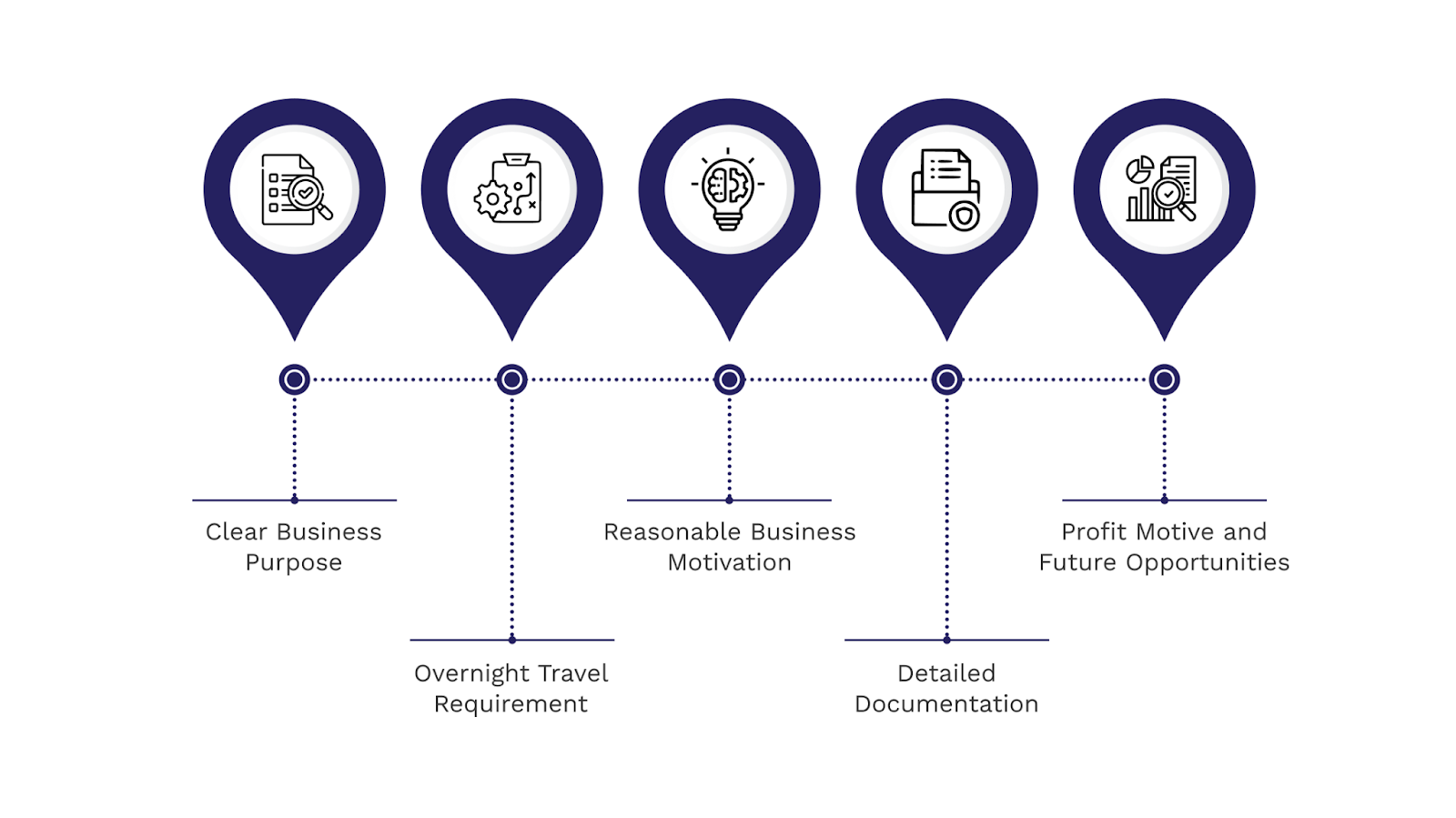
Even if your travel meets the IRS business trip rules, the IRS and courts don’t rely on a single factor to decide whether your international travel business expense is deductible. They look at the overall purpose, intent, and documentation behind the trip.
Here are some additional considerations that help determine whether your travel genuinely qualifies as business-related under international travel business rules:
- Clear Business Purpose
Your trip must have a direct connection to your trade or business, such as meeting clients, attending conferences, exploring new markets, or negotiating contracts
It’s not required to show an immediate profit, but there must be a reasonable expectation that the trip could help grow or improve your business in the long run.
- Overnight Travel Requirement
The IRS allows business travel deductions only if the trip requires you to stay overnight or long enough to need rest away from your tax home.
This distinction ensures that the expenses are related to extended business activities rather than short commutes or same-day trips.
- Reasonable Business Motivation
Ask yourself: Would a reasonable business owner take this same trip solely for business purposes? If personal enjoyment or sightseeing becomes the main motivation, the IRS will likely classify it as a vacation rather than a deductible business trip.
- Detailed Documentation
Keep organized records of everything related to your travel, meeting notes, itineraries, event confirmations, receipts, and correspondence.
Detailed proof shows that the trip served a legitimate business purpose and helps support your claim if the IRS ever reviews your deductions.
- Profit Motive and Future Opportunities
The IRS doesn’t require immediate profit from your travel, but there should be a realistic connection to future business opportunities or income generation.
Trips taken to expand markets, form partnerships, or attend industry events usually meet this criterion if properly documented.
Turn Every Business Trip into a Strategic Financial Advantage
The IRS business travel deductions framework rewards preparation, precision, and documentation. When business owners understand how these international travel business rules apply, they can plan smarter trips that meet compliance standards while maximizing legitimate deductions.
At Dahl Law Group (and at our newly-formed Dahl Tax Group), we help California business owners design compliant travel and expense planning strategies that reduce unnecessary tax exposure. With the right preparation, business travel can remain both productive and financially rewarding.
Our integrated approach helps you minimize tax exposure, stay compliant, and turn every international business trip into an opportunity for measurable business growth.
Plan. Travel smarter. Protect your profits.

Dahl Law Group
Latest posts by Dahl Law Group (see all)
- How California’s Single-Enterprise Rule Impacts Your Business - April 24, 2026