

Article Summary:
- Crypto is currently treated as property, not securities, under IRS rules.
- The wash sale rule (§1091) does not yet apply to cryptocurrency.
- You can sell crypto at a loss and repurchase immediately while still claiming the deduction.
- Congress has repeatedly tried to change this and future restrictions are likely.
- Crypto tax-loss strategies should be coordinated with your broader tax plan.
For business owners and high-income investors, tax planning is rarely about what you invest in. It’s about when and how you recognize gains and losses. When markets pull back, those losses don’t just sting; they can become powerful tools to reduce taxes, stabilize income, and improve your overall after-tax results.
In the stock market, this strategy runs straight into the wash sale rule. With crypto, it doesn’t, at least not right now.
Under current federal law, cryptocurrency is not subject to the IRS wash sale rule. That means you can sell a digital asset at a loss and buy it back immediately without automatically losing the tax deduction. This isn’t a loophole or a clever workaround. It’s simply the result of how the IRS classifies digital assets today.
That distinction creates real planning opportunities and real responsibility. The rules are evolving, government scrutiny is increasing, and what’s allowed today may not remain so forever. If crypto plays any role in your investment or business strategy, understanding why this difference exists and how long it may last is essential to making smart, defensible decisions.
What Does the Wash Sale Rule Mean for Your Tax Strategy?
The wash sale rule, found in 26 U.S. Code § 1091, applies to stocks and securities. It prevents taxpayers from claiming a capital loss if they sell an asset at a loss and repurchase the same or a “substantially identical” asset within 30 days before or after the sale.
Under this rule: If you sell a stock or security at a loss and buy the same or a “substantially identical” asset within 30 days before or after the sale, then the loss is disallowed and added to the cost basis of the new asset.
This rule is closely tied to tax-loss harvesting, which allows investors to use capital losses to offset capital gains and up to $3,000 of ordinary income each year.
So the key question becomes: Does the wash sale rule apply to crypto?
Why Crypto Follows a Different Set of Rules
The key distinction is classification. The IRS treats cryptocurrency as property, not as a security. Because the wash sale rule applies only to stocks and securities, the IRS wash sale rule crypto exception currently exists by default.
That means under current federal law:
- You can sell crypto at a loss
- You can buy the same token back immediately
- The loss is generally deductible
This is why tax-loss harvesting crypto strategies are far more flexible than those used with stocks today. This position has been widely acknowledged in tax guidance and reinforced by industry analysis. That said, just because something is allowed does not mean it is risk-free or permanent.
Why Many Investors Continue to Take a Conservative Approach
Even though wash sale rules do not currently apply to crypto, many cautious investors still wait 30 days before repurchasing the same token. Others rotate into closely correlated assets instead.
Because lawmakers have been trying to close this gap for years.
- In 2021, draft legislation proposed extending wash sale rules to digital assets. The provision appeared in multiple tax proposals but failed to pass
- The Inflation Reduction Act of 2022 ultimately removed it before enactment
- New proposals in 2024 and 2025 again sought to include digital assets, but none have cleared Congress as of early 2026
The direction of travel is clear, even if the rule has not yet changed. Building habits that mirror traditional wash sale timing now can reduce the risk of unpleasant surprises if Congress eventually extends §1091 to crypto. Because of this, many sophisticated investors choose a more cautious approach:
- Wait 30 days before repurchasing the same token
- Rotate into closely correlated assets instead of rebuying immediately.
- Carefully document business purpose and economic intent
This protects you if the crypto wash-sale rule is eventually adopted, especially if future law changes apply in the same tax year.
How the Absence of Wash Sale Rules Expands Your Tax Planning Options?
From a planning perspective, the fact that the crypto wash sale rule does not currently apply gives you significantly more control over when and how you recognize taxable income. This flexibility can be especially valuable if you are managing business income, investment gains, or year-to-year cash flow. Here’s how this works in real terms:
- Harvest Losses Without Changing Market Exposure
You can sell a cryptocurrency position at a loss, immediately repurchase the same asset, and still claim the deduction under current law. This allows you to realize tax benefits without leaving the market or altering your long-term investment strategy. - Offset Gains From Other Investments
Crypto losses can be used to offset capital gains from stocks, real estate, business asset sales, or other investments. This can materially reduce your overall tax bill in years when you realize significant gains elsewhere. - Smooth Income Volatility In High-Earning Years
If your income fluctuates, as it often does for business owners, strategic crypto tax loss harvesting can help stabilize your taxable income. In strong years, harvested losses can partially absorb higher tax exposure and improve after-tax cash flow.
This combination of flexibility, timing control, and coordination potential makes tax-loss harvesting in crypto a powerful planning tool when used deliberately and conservatively. But there are important limits and cautions:
- The IRS can still challenge transactions that lack economic substance
- Aggressive or repetitive loss harvesting can attract scrutiny
- Future legislation could apply retroactively within a tax year
In other words, technical permissibility does not eliminate risk.
Effective Strategies for Safer Crypto Tax Loss Harvesting
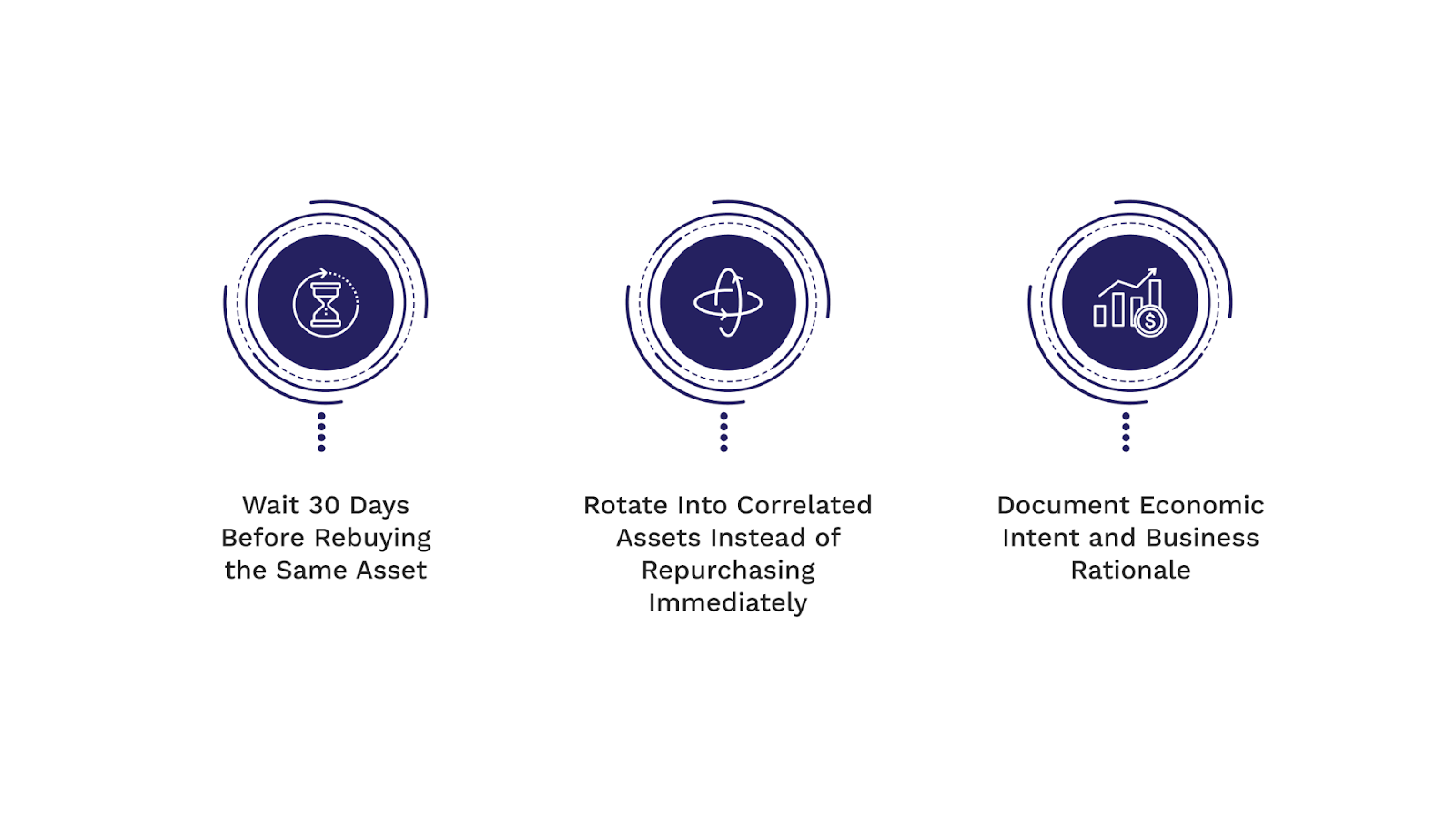
Even though the crypto wash sale rule does not currently apply under IRS guidance, many experienced investors choose a more conservative approach when implementing crypto tax loss harvesting. The goal is to capture today’s tax benefits while reducing exposure to future regulatory changes and unnecessary IRS scrutiny.
- Wait 30 Days Before Rebuying the Same Asset
Some investors voluntarily follow the traditional stock wash-sale timeline, even though the IRS wash-sale rule crypto exception still exists. Waiting 30 days before repurchasing the same token creates a clear separation between transactions and may offer additional protection if Congress later expands the rules to cover digital assets. - Rotate Into Correlated Assets Instead of Repurchasing Immediately
Another approach is to sell one token at a loss and rotate into a closely related cryptocurrency rather than buying back the exact same asset right away. This preserves market exposure while supporting a more defensible tax-loss-harvesting crypto strategy. - Document Economic Intent and Business Rationale
For larger portfolios and business owners in particular, maintaining records of your investment reasoning, risk management goals, and broader planning objectives can be invaluable. Clear documentation helps demonstrate that your transactions serve legitimate financial purposes beyond simply creating a tax deduction.
Why Establishing Balance Between Crypto and Broader Planning Objectives Matters
For business owners, crypto is often one piece of a much larger financial picture that includes operating income, equity interests, retirement accounts, and succession planning. Tax-loss harvesting strategies, crypto included, should be coordinated with:
- Overall capital gains exposure
- Cash flow needs
- Risk tolerance
- Long-term planning goals
What works in isolation can create friction elsewhere if not integrated properly.
Under current federal law, cryptocurrency is not subject to wash sale rules, allowing investors to recognize losses even when repurchasing the same asset quickly. That distinction creates planning opportunities, but also uncertainty. Congress has repeatedly signaled its interest in extending wash-sale rules to digital assets. Until that happens, careful investors balance what is permitted today with what may change tomorrow.
Align Your Crypto Decisions With Long-Term Goals

The smartest strategies are rarely about pushing boundaries. They’re about staying flexible, defensible, and aligned with long-term goals, especially in a regulatory environment that continues to evolve.
If digital assets are part of your broader investment or business strategy, tax planning should be coordinated, not reactive. Dahl Law Group helps business owners integrate crypto holdings into a larger tax and estate planning framework, with an eye toward compliance, flexibility, and long-term outcomes as the regulatory environment evolves.
Frequently Asked Questions
- Is crypto subject to the wash sale rule today?
No. Under current law, cryptocurrency is treated as property, not securities, so the wash sale rule does not apply.
- Can I sell crypto at a loss and buy it back immediately?
Generally, yes, but aggressive use of this strategy may increase audit risk, and future legislation could change the rules.
- Has Congress tried to apply wash sale rules to crypto?
Yes. Proposed legislation since 2021 has attempted to extend wash sale rules to digital assets, but none have passed as of early 2026.
- Could wash sale rules apply retroactively to crypto?
Tax law changes can sometimes apply within a tax year, which is why conservative planning remains important.
- Should crypto tax-loss harvesting be coordinated with other planning?
Yes. Crypto losses should be evaluated alongside capital gains, income levels, and long-term tax and estate planning objectives.

Dahl Law Group
Latest posts by Dahl Law Group (see all)
- How California’s Single-Enterprise Rule Impacts Your Business - April 24, 2026