
“My Insurance Will Cover It” – Why That Can Be a Risky Assumption for Landlords
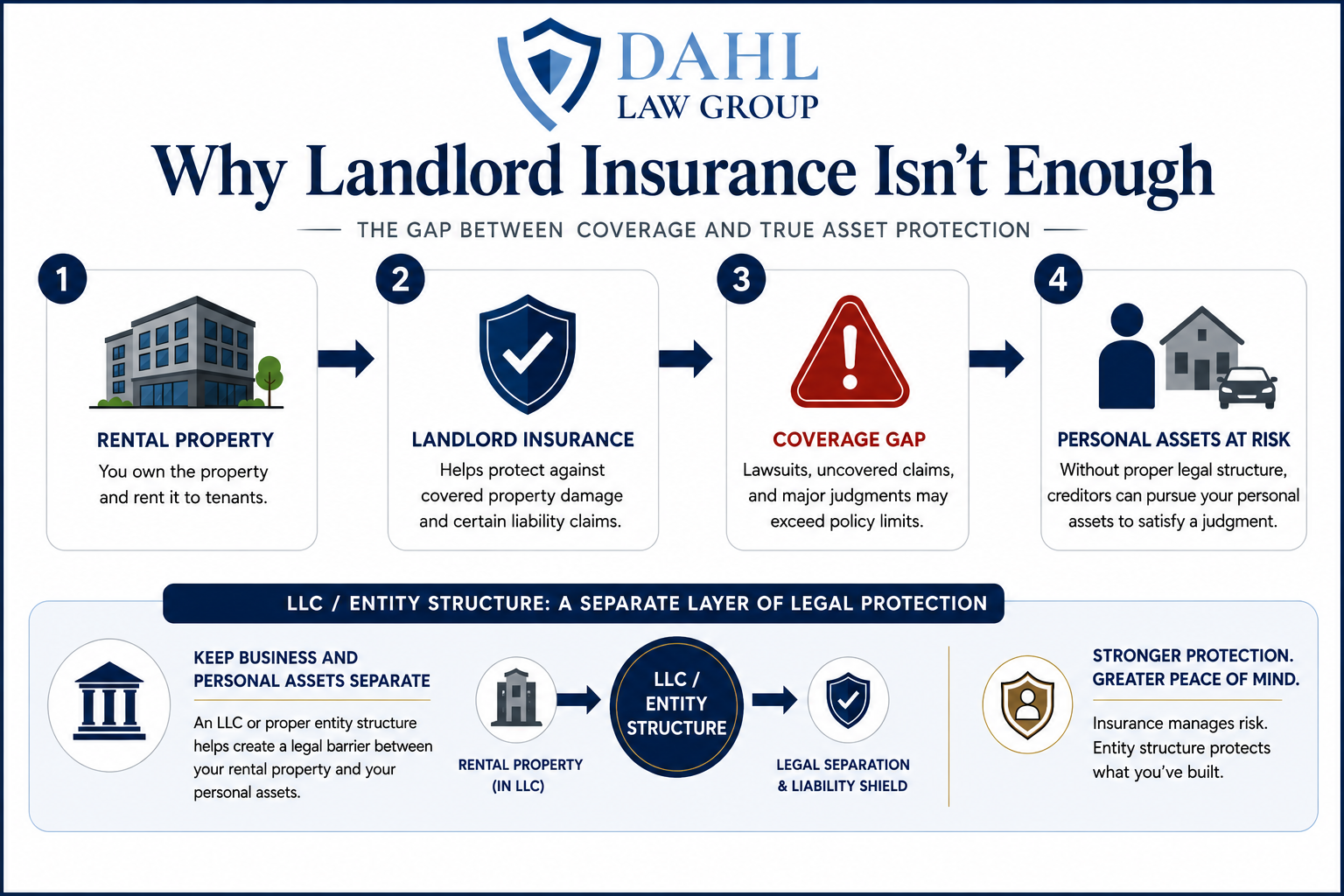
Quick Answer: Landlord insurance does not automatically make an LLC unnecessary. Insurance can pay certain covered claims, while a properly structured and maintained LLC can help separate rental-property liabilities from an owner’s other assets. The two address different risks and often work best together as part of a broader asset-protection strategy.
Meet the Whitfields
This case study is inspired by real property-ownership circumstances and a review of an actual landlord insurance policy. The Whitfields are illustrative characters, identifying details and situations have been adapted to show how coverage gaps can arise across a rental portfolio. The scenarios are not presented as actual claims involving identifiable clients.
Marcus and Elena Whitfield built Whitfield Precision Machining from a two-man garage operation into a 14-employee shop that makes custom parts for agricultural and aerospace clients across Northern California.
They did the smart thing early on. They put the business into an LLC. They keep separate books, separate accounts, and separate insurance for the operating company. Their business attorney made sure of it.
Real estate is where they got comfortable, and comfortable is where landlords can get exposed.
Over 12 years, the Whitfields bought four residential rentals and the commercial building their own business operates out of. All five sit in Marcus and Elena’s personal names.
Here’s their portfolio:
- 4520 Fulton Avenue, Sacramento – the commercial building where Whitfield Precision Machining operates. Owned personally by Marcus and Elena and leased to their own LLC.
- An Arden-Arcade duplex – long-term tenants, the Beckham family, who run a small unlicensed home daycare out of one unit to make extra income.
- A single-family home in Elk Grove – tenant Danny Ruiz, a mechanic who does side work on cars in the garage on weekends.
- A craftsman home in Carmichael, near the American River – tenants the Okafor family.
- A townhome in Rancho Cordova – tenant Priya Anand, who quietly lists the second bedroom on Airbnb without telling the Whitfields.
The assumption underlying the Whitfields’ approach can be summed up this way:
“We carry a $2 million umbrella on top of everything. If something happens, we’re covered.”
Elena assumed the same thing.
Neither of them had ever actually read the exclusions page of their landlord policies.
The Whitfields’ situation illustrates why an insurance-policy review can be as important as purchasing coverage in the first place.
A close review of the landlord policy used for this case study reveals ten categories of losses that are excluded or sharply limited. Each raises a practical question for the Whitfields, whose properties could be affected by tenant activity, maintenance issues, and other risks they may not anticipate.
That distinction matters. Every insurance policy has its own terms, but coverage is defined not only by what the policy covers, but also by its exclusions, limits, conditions, and endorsements. The California Department of Insurance’s residential insurance guidance specifically advises policyholders to read their exclusions and identifies risks such as mold and water damage from seepage or leaks among those commonly excluded from homeowners coverage.
This is why “we have insurance” is not the same thing as “everything is protected.”
Does Landlord Insurance Make an LLC Unnecessary?
Generally, no. Landlord insurance and LLC ownership address different types of risk. Insurance can provide money to defend or pay a covered claim, subject to the policy’s exclusions and limits. Entity structuring addresses a different question: if a liability is not covered-or exceeds available coverage-what other assets may be exposed?
An LLC is not an absolute liability shield. Its effectiveness depends on the circumstances, including how the entity is formed and maintained, whether business and personal finances are kept separate, whether the owner has personally assumed liability, and the nature of the claim.
But the distinction matters.
The California Secretary of State’s guidance on business entities explains that a California LLC generally offers liability protection similar to that of a corporation.
That makes insurance and entity planning complementary tools-not substitutes for one another.
For a broader look at how insurance, legal structure, and liability exposure fit together, read Dahl Law Group’s Asset Protection for Business Owners in California. Dahl’s approach treats insurance alignment and entity structure as parts of a coordinated asset-protection strategy rather than isolated planning decisions.
Quick-Look Summary
What the Whitfields’ Insurance Review Reveals
- 10 distinct exclusion categories across property damage and liability coverage-not a handful, but a list that runs the length of this article.
- Several can potentially be triggered by tenant or guest behavior the property owner may not have known about or authorized.
- A $5,000 sublimit is the entire mold coverage available under the policy examined for this case study, and only when the mold traces to an otherwise covered peril.
- A $5,000 endorsement, purchased separately, is required under this policy to obtain limited sewer and sump backup coverage.
- Lead paint liability is completely excluded under the policy examined for this case study.
- Unauthorized home-sharing activity can create significant coverage problems, depending on the facts and policy language.
- An umbrella policy does not automatically fill every gap in an underlying landlord policy. Umbrella policies have their own terms, conditions, and exclusions.
- Policy limits matter even when a claim is covered. A significant bodily injury or property claim can potentially exceed the liability coverage available under a landlord policy.
None of this necessarily requires the property owner to make the initial mistake.
Sometimes it only requires a tenant, guest, property condition, or ordinary use of the property to intersect with an exclusion or limitation in the insurance contract.
10 Insurance Exclusions and Limitations That Matter to the Whitfields
All ten deserve attention—not just the most dramatic—because the number and variety of exclusions are part of the lesson.
Landlords who think “insurance has me covered” are usually thinking about obvious risks like a fire, a burst pipe, or someone falling on the property.
Those are only part of the risk picture.
The following Whitfield scenarios illustrate how exclusions and limitations documented in an actual landlord policy could affect rental-property owners. The family and property-specific details have been adapted for this case study; these scenarios should not be read as verified claims or coverage determinations involving actual clients. Other landlord policies may have different terms, exclusions, endorsements, limits, and definitions. Property owners should review their own contracts with their insurance professionals.
Property Damage Exclusions
1. Long-Term Water Leaks
What the policy examined in this case study excludes: Constant or repeated seepage, leakage running 14 days or more, long-term moisture intrusion, and ongoing condensation.
How this could affect the Whitfields: In the Beckham duplex, a slow drip under the kitchen sink goes unreported for two months because the Beckhams don’t want to draw attention to anything while they’re running an unlicensed daycare out of the unit.
By the time it’s discovered, mold has spread into the subfloor and cabinetry. The adjuster’s first question is how long the leak had been running. Under the policy terms reviewed for this article, the duration of the leak creates a serious coverage problem.
The Beckhams didn’t deliberately cause the damage. They simply stayed quiet.
The exclusion doesn’t necessarily care why.
The California Department of Insurance similarly identifies water damage caused by seepage or leaks as a category generally not covered under homeowners policies, while emphasizing that the actual policy language controls.
2. Mold, Fungus, Rot, and Microbial Growth
What the policy examined in this case study excludes or limits: Mold and fungus damage is generally excluded, with a narrow carve-out of up to $5,000 per policy period when the mold was caused by an otherwise covered peril.
How this could affect the Whitfields: Because the Beckham duplex leak already falls outside the policy’s specified leakage period, the resulting mold may never reach the $5,000 sublimit conversation. The underlying cause of the mold can determine whether the limited mold coverage applies at all.
That distinction is important. Mold coverage is highly policy- and cause-specific. The California Department of Insurance identifies mold as commonly excluded and recommends reviewing the policy itself and available endorsements to determine the coverage actually provided.
3. Pollutants / Environmental Cleanup
What the policy examined in this case study excludes: Environmental contamination, cleanup obligations, hazardous substances, and government-mandated remediation.
How this could affect the Whitfields: Danny Ruiz has been changing oil and disposing of used fluids behind the Elk Grove garage for two years without telling anyone.
The county eventually identifies soil contamination during an inspection and orders remediation.
The Whitfields never authorized the activity and never knew it was happening.
But whether the owner knew about the activity and whether the resulting environmental loss is insured are two separate questions.
4. Illegal Activity
What the policy examined in this case study excludes: The California endorsement includes exclusions involving certain illegal cultivation, illegal animal operations, and manufacturing or processing operations conducted on the property.
How this could affect the Whitfields: Danny Ruiz starts taking on paying customers for brake jobs and oil changes out of the Elk Grove garage, turning his weekend hobby into an unlicensed commercial auto-repair operation in a residential area.
A customer’s vehicle catches fire in the garage, damaging the structure and injuring the customer.
The Whitfields didn’t know Danny had turned his hobby into a business.
That does not necessarily mean the resulting loss is covered.
Residential insurance policies commonly contain restrictions involving business activities. The California Department of Insurance, for example, expressly notes that business activities are excluded from standard homeowners liability coverage. The exact result under a landlord policy depends on the policy language and circumstances of the loss.
Liability Exclusions
5. Lead-Based Paint
What the policy examined in this case study excludes: Liability arising from lead, lead pigment, or lead compounds, including bodily injury and remediation-related claims. Under this particular policy, there is no dollar sublimit-it is a complete exclusion.
How this could affect the Whitfields: The Rancho Cordova townhome was built in 1961. Priya Anand does some minor DIY work herself, sanding down a window frame to repaint it and disturbing old lead paint dust in the process.
Months later, her young niece, who stays with her regularly, tests positive for elevated blood lead levels during a pediatric visit. A lawsuit follows.
The Whitfields never touched the window and never knew about the sanding. But the policy’s lead exclusion creates a potentially significant uninsured exposure.
Lead risk deserves particular attention with older rental properties. The EPA’s Lead-Based Paint Disclosure Rule guidance explains federal disclosure requirements for landlords of most pre-1978 housing.
6. Communicable Disease
What the policy examined in this case study excludes: Certain disease-transmission and communicable-disease claims.
How this could affect the Whitfields: The unlicensed daycare the Beckhams run out of their duplex unit exposes several children to a contagious illness that spreads through the group.
One parent, learning that the daycare was operating out of a rental property, adds the Whitfields to a demand letter alongside the Beckhams.
Under the policy examined for this case study, the communicable-disease exclusion creates a potential coverage gap.
7. Mold Liability
What the policy examined in this case study excludes: Liability claims arising from mold or fungus exposure, separate from the limited property-damage coverage discussed above.
How this could affect the Whitfields: A subsequent tenant moves into the Beckham duplex after the undetected long-term leak and resulting mold and develops respiratory symptoms within weeks.
The claim is framed as bodily injury from mold exposure.
That creates a different issue from paying to repair mold damage to the building itself. Under the policy examined here, mold-related liability is separately excluded.
8. Pollution Liability
What the policy examined in this case study excludes: Liability claims tied to pollution.
How this could affect the Whitfields: A neighbor near the Elk Grove property tests their well water and finds contamination consistent with the used motor oil Danny Ruiz had been dumping.
The neighbor sues the Whitfields as the property owners.
Now the Whitfields potentially face both the cost of contamination involving their property and a third-party liability claim-two different exposures that may implicate separate exclusions.
9. Fuel Tank / Fuel System Liability
What the policy examined in this case study excludes: Certain claims involving leaking fuel oil, gasoline, kerosene, or propane.
How this could affect the Whitfields: Danny Ruiz keeps a propane heater running in the Elk Grove garage during cold months while he works on cars.
A leak causes a flash fire that injures a friend helping him with a project.
The important question for the Whitfields is not simply whether they knew the heater existed. It is whether the resulting claim falls within the terms of their liability coverage or one of its exclusions.
10. Home-Sharing and Airbnb Issues
What the policy examined in this case study excludes: Certain property and liability losses connected to home-sharing, including categories involving guest property, theft or vandalism, and certain home-sharing-related liability unless appropriate coverage has been added.
How this could affect the Whitfields: Priya Anand has been quietly listing the second bedroom of the Rancho Cordova townhome on Airbnb for over a year.
A short-term guest falls down the stairs late at night and sues.
The Whitfields have never heard of the listing.
The fact that the home-sharing activity was unauthorized does not automatically mean their insurance will respond. Home-sharing can materially change the risk being insured, and coverage depends on the policy, endorsements, facts of the claim, and how the property was being used.
The National Association of Insurance Commissioners’ home-sharing insurance guidance notes that many homeowners or dwelling policies are not designed for accidents arising from short-term rentals and that paying guests may be excluded or receive limited coverage.
A Note on Scope
This list focuses primarily on exclusions and limitations that can intersect with tenant or guest behavior.
Landlord policies can contain many other exclusions involving the owner’s conduct, property condition, business use, professional services, vacancy, maintenance, or other circumstances.
The point is not that every landlord policy contains these exact ten exclusions.
The point is that insurance contracts define boundaries around what the insurer has agreed to cover. Those boundaries matter-and landlords may not discover where they are until a claim occurs.
The Common Thread
Look back across the ten Whitfield examples.
Several don’t require Marcus or Elena to participate in the conduct creating the risk. In some, they don’t even know what’s happening on their own property.
That is the real lesson.
Owning rental property means accepting risk created not only by your own decisions, but also by tenants, guests, contractors, property conditions, and uses you may not have authorized.
Insurance is designed to transfer certain defined risks.
It does not transfer every risk.
That is why reading the actual policy matters-and why insurance should be considered alongside the way the property itself is owned.
For more on the insurance side of that equation, see Dahl Law Group’s Insurance Policies You Need to Protect Your California Properties.
Does Umbrella Insurance Cover Landlord Insurance Gaps? The Whitfields’ $2 Million Example
Sometimes-but not automatically. An umbrella policy can provide additional liability protection beyond underlying insurance and may cover certain liability claims a primary policy does not. But an umbrella has its own terms and exclusions, so an owner cannot assume that every gap in a landlord policy will be covered.
This is where the Whitfields’ situation becomes more nuanced.
The National Association of Insurance Commissioners’ umbrella policy guidance explains that a personal umbrella may cover certain liability claims the primary policy does not cover and may also pay liability and defense costs above the amount the primary policy will pay.
So Marcus’s $2 million umbrella is a real asset.
If a covered claim produces liability beyond an underlying policy limit, for example, an umbrella may provide substantial additional protection.
But Marcus cannot safely conclude:
“The landlord policy doesn’t cover it, so the umbrella will.”
Whether the umbrella responds to an Airbnb guest injury, mold claim, lead-related claim, pollution claim, or another excluded loss requires an analysis of the umbrella policy itself.
An umbrella is another layer of protection.
It is not a guarantee that every hole in the underlying insurance program has been filled.
“I’ll Just Sue the Tenant” – Why Lease Remedies May Not Make You Whole
When landlords learn that a tenant’s unauthorized conduct may have caused an uninsured loss, a common next thought is: “The lease prohibits this. If something happens, I’ll go after the tenant.”
That instinct is understandable. Most well-drafted leases restrict business use, subletting, and alterations, and many require the tenant to indemnify the landlord for losses the tenant causes. In the Whitfields’ case, the Beckhams’ unlicensed daycare, Danny Ruiz’s auto-repair work and oil dumping, and Priya Anand’s Airbnb listing may all violate the terms of their leases.
But a right to sue is not the same thing as a right to collect.
Consider what happens if the Airbnb guest who fell at the Rancho Cordova townhome sues the Whitfields for a serious injury. The Whitfields may have a strong breach-of-lease or indemnity claim against Priya. But if Priya has modest income, little savings, and no significant assets, a judgment against her may be worth very little in practice. The same is true if Danny Ruiz’s neighbor brings a contamination claim: the cost of remediation and third-party damages could far exceed anything a working mechanic could realistically pay.
Several practical obstacles can stand between a landlord and recovery from a tenant:
Limited assets: Many tenants do not own real estate or hold substantial savings or investments that can be reached to satisfy a judgment.
Exempt property: California law protects certain categories of a debtor’s property and wages from collection, which can limit what a judgment creditor can actually reach.
Renters insurance gaps: Even if a lease requires renters insurance, the tenant may have let it lapse, carried low limits, or carried a policy that excludes the same business, home-sharing, or pollution activity that caused the loss.
Bankruptcy: A tenant facing a large judgment may seek bankruptcy protection, which can stop or limit collection efforts.
Time and cost: Pursuing a separate claim against a tenant requires additional legal fees and time, often while the landlord is already defending the third party’s lawsuit.
Meanwhile, the injured third party may pursue the property owner directly, often because the owner is perceived as the party with insurance, real estate equity, and other collectible assets. For owners like the Whitfields, who hold five properties in their personal names, that perception may be accurate.
This does not mean lease protections are unimportant. Clear use restrictions, subletting prohibitions, indemnification provisions, and renters insurance requirements with meaningful limits remain valuable tools. They can deter problem conduct and, in some cases, support recovery.
But a lease is only as strong as the tenant’s ability to pay. For that reason, landlords should not treat lease remedies as a substitute for appropriate insurance or a thoughtful ownership structure.
Why This Is an Entity Structuring Conversation, Not Just an Insurance Conversation
Here’s the irony in the Whitfields’ situation.
Their business-the asset operating day to day with employees, equipment, and clients-sits inside an LLC.
Their five real estate holdings sit in their personal names.
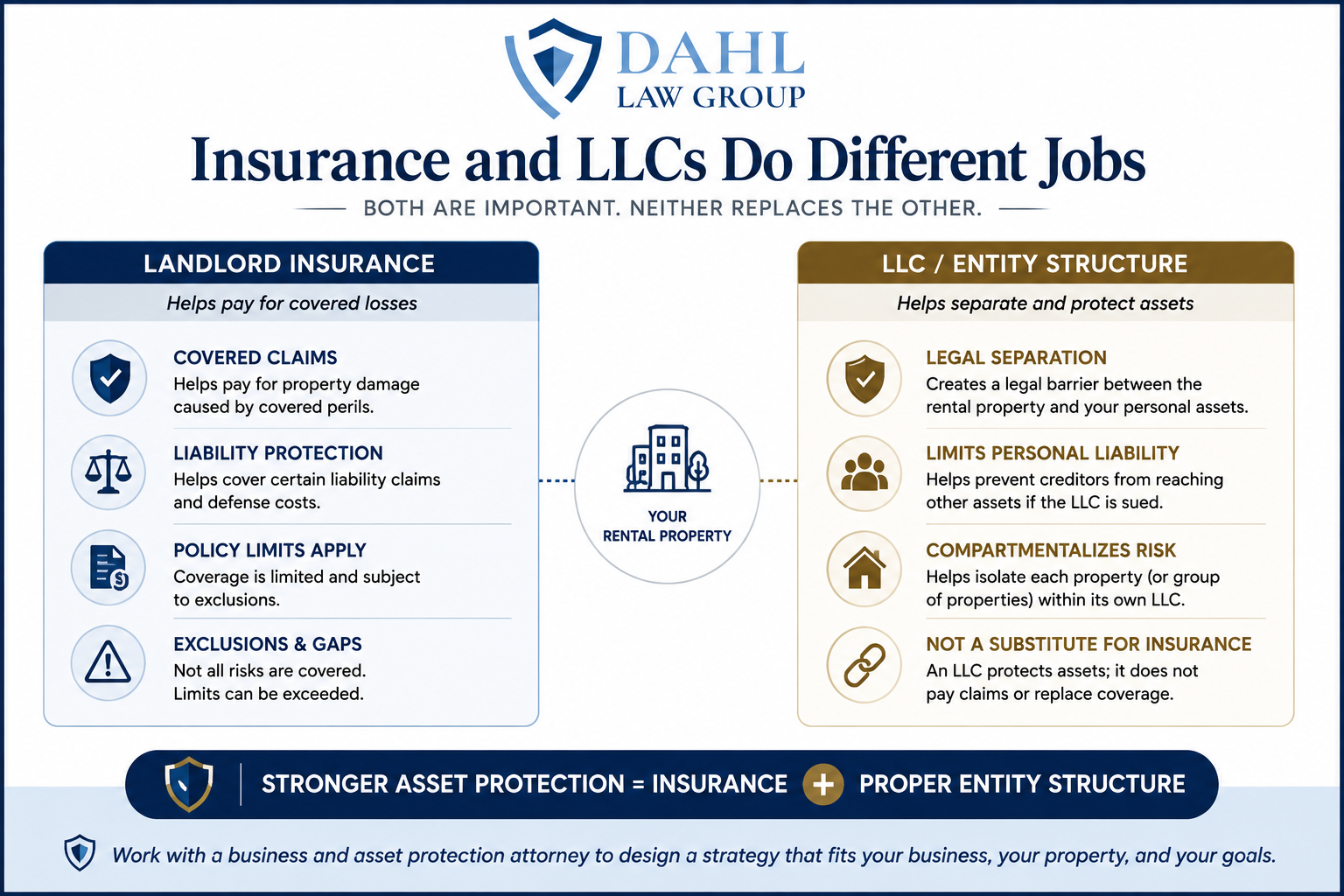
Insurance and entity structure solve different problems.
Insurance can fund the defense or payment of a covered claim, subject to its terms and limits.
Entity structure can help determine where liabilities are housed and which assets may be exposed when a claim is uninsured, underinsured, or otherwise reaches beyond available insurance.
That does not mean putting a rental property into an LLC makes it lawsuit-proof.
It doesn’t.
An LLC’s effectiveness depends on factors such as proper formation, operational discipline, separation of personal and entity finances, personal guarantees, the owner’s own conduct, and the nature of the claim.
Dahl Law Group discusses the importance of layered planning in 7 Asset Protection Strategies California Business Owners Must Consider and also addresses the misconception that an entity creates absolute liability protection in 4 Myths and Misconceptions About Business Entities.
But appropriate entity structuring can help compartmentalize risk.
Imagine the Whitfields’ five properties are evaluated individually rather than automatically being held together in Marcus and Elena’s personal names. Depending on their legal, tax, financing, insurance, and operational circumstances, separate entities may help create legal boundaries between different properties and reduce the risk that a liability associated with one investment exposes unrelated assets.
That is materially different from assuming:
“We have a $2 million umbrella, so everything we own is protected.”
For the Whitfields, the better question isn’t whether they should have insurance or LLCs.
It is whether their insurance coverage, property ownership, entity structure, tax planning, and broader asset-protection strategy actually work together.
Insurance is often the first layer.
Entity structuring can be another.
Neither should be evaluated in isolation.
Frequently Asked Questions
Landlord insurance does not automatically eliminate the potential value of an LLC. The two serve different purposes: insurance transfers certain covered risks to an insurer, while an appropriately structured and maintained LLC can help separate liabilities associated with a rental property from an owner’s other assets. Whether an LLC is appropriate for a particular property depends on the owner’s legal, tax, financing, insurance, and broader asset-protection circumstances.
No, not completely. Landlord insurance can protect against covered property and liability claims, but coverage is subject to the policy’s exclusions, limits, deductibles, and conditions. If a claim is excluded or exceeds available coverage, an owner may still face personal exposure depending on how the property is owned and the circumstances of the claim.
Generally, no-but it depends on the cause of the mold and the specific policy. Mold is commonly excluded or subject to limited coverage, but mold resulting from an otherwise covered event may receive some coverage. Long-term seepage, maintenance issues, or excluded water losses are much less likely to be covered. The specific policy language controls.
No, not necessarily as coverage depends on the policy. The landlord policy examined for this case study contains a complete exclusion for lead-related liability. Other policies may treat lead-related claims differently, so owners-particularly those with pre-1978 rental housing-should review their exclusions and endorsements carefully. Federal law also imposes lead-disclosure requirements on landlords of most pre-1978 housing.
No, not necessarily. Unauthorized home-sharing can create significant coverage issues. Whether a guest injury is covered depends on the landlord policy, any home-sharing exclusions or endorsements, the use of the property, and the circumstances of the claim. An owner should not assume that lack of knowledge about a tenant’s Airbnb activity guarantees coverage.
Generally, no-but coverage depends on the policy and the circumstances of the claim. Residential insurance policies commonly restrict or exclude losses connected to business activities, particularly unauthorized or illegal operations. Whether a particular loss is covered can depend on the activity, what caused the loss, and the policy’s specific exclusions. In the policy examined for this case study, certain illegal or unauthorized operations are expressly excluded.
Sometimes, but not automatically. An umbrella policy may cover certain liability claims that a primary policy does not, but umbrella policies also contain their own terms and exclusions. Whether an umbrella fills a particular coverage gap requires reviewing both the underlying policy and the umbrella policy.
There is no single tool that protects against every claim. Entity structure, insurance, ownership arrangements, statutory protections, contracts, and other asset-protection strategies can work together to reduce exposure. A properly structured and maintained LLC may help compartmentalize certain property-related liabilities, but LLC protection is not absolute.
Where This Fits in Your Overall Plan
The Whitfields didn’t ignore risk.
They bought landlord insurance. They bought a $2 million umbrella. They even understood the value of an LLC well enough to use one for their operating business.
Their blind spot was assuming those pieces protected the same things.
They don’t.
The lesson isn’t that insurance doesn’t work. The lesson is that insurance and entity structuring do different jobs.
Insurance can be an essential first line of defense. But exclusions, policy limits, tenant behavior, property use, and other circumstances can create risks that insurance does not fully absorb.
Entity structuring can add another layer by helping create boundaries between assets and liabilities-but it also has to be implemented and maintained correctly.
The strongest planning asks how those layers interact before a claim happens.
That is the broader approach behind Dahl Law Group’s asset-protection planning: legal structure, insurance strategy, tax considerations, ownership, and long-term planning should be evaluated as parts of the same system rather than as isolated documents.
If you hold rental property-or a building your own business operates out of-in your personal name and are relying primarily on insurance to protect the rest of your assets, it may be worth examining where your coverage ends and what your ownership structure does after that point.
A Dahl Law Group Strategy Session is designed to evaluate how your current structure, liability exposure, insurance alignment, tax considerations, and other planning pieces work together.
The question isn’t simply, “Do I have insurance?”
It’s, “If something happens that my insurance doesn’t fully cover, what happens next?”

Dahl Law Group
Latest posts by Dahl Law Group (see all)
- Can an LLC Own S Corporation Stock? What Business Owners Should Know - November 10, 2026