

When you co-own corporate stock with a business partner, sibling, or investor, you’re not just choosing a title; you’re choosing what happens to your shares when life changes. And in California, that decision matters a lot more than most owners realize.
This is especially true in company stock ownership situations where multiple stakeholders share control, and in broader joint stock company ownership structures where succession planning must be precise.
If something happened to you tomorrow, who should end up with your shares, your co-owner, or your family/beneficiaries?
If your stock is held in joint tenancy, your answer might not matter, because the right of survivorship can automatically transfer your interest to the surviving owner. That may be convenient, or it may completely override your succession plan.
This is why many California owners shift from joint tenancy to tenancy in common.
Naturally, the next question is the one that stops people in their tracks:
“If we change the ownership structure, are we triggering taxes?”
The good news is that the IRS has addressed this. You can usually align ownership with your estate or succession plan without creating a tax bill, and that gives California business owners a practical way to protect both their businesses and their beneficiaries.
Joint Tenancy vs. Tenancy in Common: What Business Owners Need to Know
Choosing how to hold property with a co-owner isn’t just a legal formality, it directly affects control, succession, and long-term business planning. The two most common ownership structures are joint tenancy and tenancy in common, and the difference between them is critical.
Joint Tenancy: Automatic Transfer to the Survivor
With joint tenancy, all co-owners hold equal rights to the property. The key feature is right of survivorship:
- If one owner dies, their share automatically transfers to the surviving owner(s).
- That transfer occurs outside a will or trust and usually doesn’t go through probate.
It is simple and fast for a surviving owner. It may override estate plans or succession intentions, for example, a share you wanted to pass to heirs could go directly to a business partner instead.
Tenancy in Common: Ownership With Flexibility
A tenancy in common removes the survivorship rule. Each owner holds a separate share, which can be equal or unequal, and that share is treated as part of their estate. This means:
- An owner’s interest can pass through a will, trust, or business succession plan.
- Ownership can be transferred, sold, or reassigned more easily over time.
For business owners, this structure often aligns better with long-term planning, especially when multiple stakeholders, family members, or successors are involved.
Why Ownership Structure Shapes Your Succession Plan?
If you want control over who inherits your ownership share, whether that’s family, partners, or beneficiaries, joint tenancy may be too rigid. Tenancy in common gives you the freedom to:
- Direct your share according to your succession strategy
- Shift ownership gradually as roles change.
- Plan around family businesses or closely held corporations to avoid surprises from automatic transfers.
In short, joint tenancy prioritizes simplicity for the survivor, while tenancy in common prioritizes control for the owner.
Situations Where Tenancy in Common Works Best
Business owners often consider switching to tenancy in common when they need:
- Clear succession planning
- Flexibility to adjust ownership later
- More effortless transfer of shares to heirs or new partners
- Reduced risk of unintended survivorship outcomes
This is especially relevant in family-owned businesses, partnerships, or any situation where ownership needs to evolve.
Why the IRS Treats This as a Nontaxable Transaction?
When jointly held stock is retitled, whether owners agree to it voluntarily or a court orders it, the IRS generally does not treat the change as taxable. The controlling guidance here is Revenue Ruling 56-437, which says explicitly that converting a joint tenancy in corporate stock into a tenancy in common (including via partition) is a nontaxable event for federal income tax purposes.
Although this isn’t a tax-free exchange of stock, the IRS applies similar nonrecognition logic because no value is being traded between owners. The IRS view is straightforward:
- Nobody is selling anything.
- Nobody is exchanging one asset for another.
- Each owner keeps the same proportional ownership in the same underlying shares.
So even though the title changes, the economics don’t. Because there’s no disposition of property under the tax rules, there’s no realized gain or loss, and therefore no income to recognize.
In many conversions, the corporation issues new stock certificates to reflect the updated ownership form. Revenue Ruling 56-437 makes clear that this is an administrative matter, not a transfer of value. The paperwork changes, but ownership value stays the same, so tax treatment remains the same, too.
Practical Steps to Keep the Restructuring Nontaxable
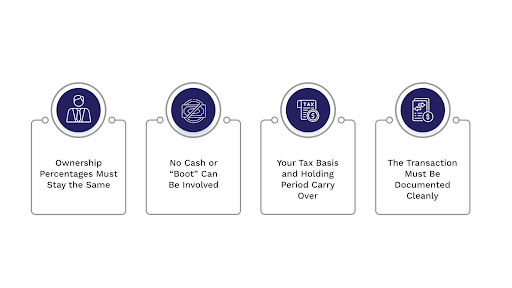
The IRS’s nonrecognition position is clear, but it’s not a blanket “anything goes.” The conversion stays nontaxable only if the change is purely a retitling and not an economic transfer.
This kind of clean retitling is sometimes described in practice alongside tax-free reorganization concepts, because the result is still nonrecognition without an actual sale. To stay within the safe lane described in Revenue Ruling 56-437 and later IRS guidance:
-
Ownership Percentages Must Stay the Same
Each co-owner has to end up with the same proportional interest they had before the change. The IRS treats the transaction as nontaxable precisely because no one’s economic stake shifts; only the legal form does.
-
No Cash or “Boot” Can Be Involved
If one shareholder pays the other to “even things out,” or receives extra value in the process, that starts looking like a sale or exchange, which can trigger gain under standard tax rules. The ruling’s protection applies when there’s no transfer of value between owners.
-
Your Tax Basis and Holding Period Carry Over
Because the IRS views this as an administrative restructuring, not a disposition, each owner generally keeps the same tax basis and holding period in their shares after the conversion. Practically, that means you don’t “reset” anything for future capital gains calculations.
-
The Transaction Must Be Documented Cleanly
Even when taxes aren’t triggered, sloppy documentation can cause problems later (partner exits, estate transfers, audits, or disputes). Make sure the corporation updates:
- Shareholder records,
- Certificates/ownership ledger, and
- Any related buy-sell or succession documents.
Ensure the corporation’s records match the new structure, and keep clean supporting paperwork.
That protects you later, especially in succession planning, partner exits, or audits, by avoiding disputes about who owns what and under which structure.
Align Your Stock Ownership With Your Succession Plan

Changing stock ownership from joint tenancy to tenancy in common can be a sound estate and business planning decision, but it should never be done in isolation. The ownership structure affects:
- Voting rights,
- Buy-sell agreements, and
- Distribution of shares upon death.
Before making any changes, it’s critical to confirm that corporate records, shareholder agreements, and estate planning documents are all consistent.
At Dahl Law Group, we help California business owners and families make informed decisions about how they hold and transfer assets.
Our team ensures that ownership changes are documented correctly and that every decision aligns with broader goals for control, taxation, and legacy.
Review your corporate ownership structure today to ensure it fully supports your long-term financial, estate, and succession planning goals.

Dahl Law Group
Latest posts by Dahl Law Group (see all)
- How California’s Single-Enterprise Rule Impacts Your Business - April 24, 2026