

Article Summary
- Personal goodwill exists when a business’s value is tied to the individual owner rather than the entity.
- When properly supported, personal goodwill can be sold separately and taxed at long-term capital gains rates if your business is taxed as a C-corporation, which can provide beneficial tax treatment.
- Whether it exists depends on contracts, relationships, and business structure, making early planning critical for owners considering future succession or sale.
When you start thinking about selling your business, your attention naturally goes to valuation, deal structure, and what life looks like after closing. What often gets overlooked, until it’s too late, is how much of the sale proceeds you’ll actually keep after taxes.
For owners whose businesses are closely tied to their personal relationships, reputation, and expertise, one concept can materially change that outcome: personal goodwill.
In the right circumstances, personal goodwill may be taxed at long-term capital gains rates, rather than subject to corporate-level tax if your business is taxed as a C-corporation and is selling its assets in a sale. That difference is not marginal.
Depending on deal size and entity structure, it can translate into hundreds of thousands, or even millions of dollars in additional after-tax proceeds. Courts have recognized this distinction for decades, and the IRS continues to evaluate it closely in business sales.
But personal goodwill is not automatic. You cannot create it by inserting a clause into a purchase agreement after a buyer appears. It must exist in reality, based on how your business has operated over time, who truly owns the customer relationships, and what your contracts say. The law also requires the deal structure to be negotiated from the beginning, not a last-minute effort to save in taxes. If your business depends on you, but your structure says otherwise, the structure wins.
That’s why personal goodwill is not a last-minute tax tactic. It’s a forward-looking business planning issue that needs to be addressed well before a sale is on the table.
What Is Personal Goodwill?
Goodwill generally refers to the value of a business beyond its tangible assets, like reputation, relationships, and earning power. But goodwill is not always owned by the company itself.
Personal goodwill exists when the value of the business is tied directly to the individual owner, rather than to the entity. Common examples include:
- Personal client or customer relationships
- Individual reputation in the market
- Specialized skills or knowledge unique to the owner
- Referral networks built personally, not through the company
If customers do business because of you and would likely leave if you left, personal goodwill may exist.
By contrast, enterprise goodwill belongs to the company. It comes from brand recognition, systems, workforce, contracts, and processes that survive a change in ownership. This distinction is the foundation of personal goodwill tax planning.
How Is Personal Goodwill Treated for Tax Purposes?
The reason personal goodwill matters is simple: the tax treatment is different. If you have an S-corporation and you are selling your assets, selling goodwill by you personally (instead of through the corporation) won’t matter due to the pass-through taxation.
However, when you are selling assets through your C-corporation, and including goodwill, that purchase price will be “double taxed” – once at the corporate level and then again at the shareholder level. This results in exponentially higher taxes.
When personal goodwill is properly identified and sold by you personally:
- You sell the asset directly to the buyer as an individual
- The gain is generally taxed as long-term capital gain (if held more than one year)
That is very different from:
- Consulting or employment payments (taxed as ordinary income)
- Corporate goodwill in a C corporation (subject to corporate tax and a second-layer tax on distribution)
This is why owners often ask how personal goodwill is taxed compared to business assets or goodwill. The answer can mean a materially lower effective tax rate.
The concept has been recognized by courts for decades. Two often-cited cases are Martin Ice Cream Co. v. Commissioner and Norwalk v. Commissioner, both of which confirmed that goodwill can belong to the individual rather than the company when the facts support it.
When Personal Goodwill Exists and When It Doesn’t
You cannot create personal goodwill by labeling it in a purchase agreement. The IRS looks at substance, history, and documentation. Personal goodwill is more likely when:
- You have not signed employment or noncompete agreements assigning goodwill to the company
- Client relationships are personal and portable
- The business would lose value if you exited
- The brand is closely tied to your identity
Personal goodwill is less likely when:
- Restrictive covenants transfer goodwill to the entity
- Customers are loyal to the company brand, not you
- Systems and teams operate independently of your involvement
Once goodwill has been transferred to the company, explicitly or implicitly, it is generally no longer personal. That directly affects the goodwill sale of business tax treatment.
The Structural Factors That Control Personal Goodwill
If you want personal goodwill to be respected and taxed favorably, it has to exist before a buyer appears. Once a deal is in motion, your flexibility is extremely limited. The way your business has been structured over time is what determines the outcome. Here’s how the key structural documents affect personal goodwill:
- Employment Agreements
If your employment agreement states that customer relationships, intellectual capital, or goodwill belong to the company, the IRS may view that goodwill as corporate property. This can eliminate your ability to claim personal goodwill at the sale, even if clients primarily do business with you.
- Noncompete Agreements
Noncompetes signed early in the business’s life often assign goodwill to the entity by default. If you’ve already agreed not to compete on behalf of the company, it may be evidence that the goodwill was transferred long ago.
- Buy-Sell Agreements
These agreements frequently define what is being bought and sold between owners. If goodwill is treated as a company asset in a buy-sell, it becomes difficult to later argue that any portion of that goodwill is personal.
- Equity Compensation Arrangements
Stock options, profit interests, or incentive plans can imply that value, including goodwill, belongs to the entity. Poorly drafted plans may unintentionally shift personal value into the business.
If these documents assign goodwill to the company, your ability to claim favorable personal goodwill tax treatment may already be gone. Trying to reverse this at the last minute rarely works under IRS scrutiny.
For business owners thinking about succession, growth, or eventual exit, this is not just a tax question. It’s a business planning issue that touches governance, contracts, and long-term strategy.
How Personal Goodwill Fits Into Business Succession?
If your business generates $10M+ in annual revenue, a meaningful portion of its value is often tied directly to you.
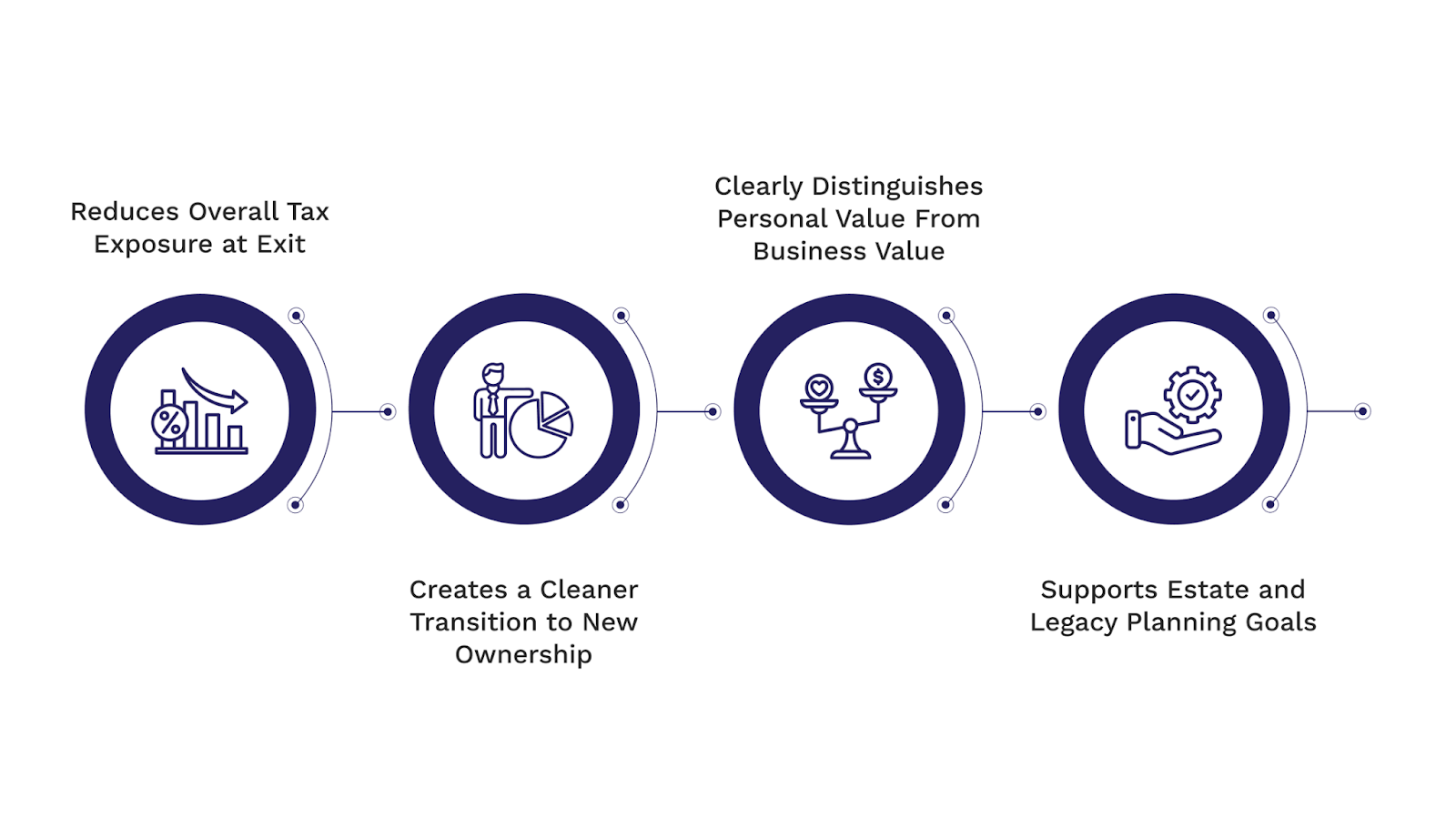
Personal goodwill usually reflects years, sometimes decades, of trust, credibility, and relationship-building. When recognized and structured correctly, it plays a critical role in succession planning. Here’s how personal goodwill supports a well-executed transition when selling assets in a C-corporation:
- Reduces Overall Tax Exposure at Exit
Properly identified personal goodwill may be taxed at long-term capital gains rates, which are lower than ordinary income or corporate-level tax rates.
- Creates a Cleaner Transition to New Ownership
Separating personal goodwill from enterprise value clarifies what the buyer is acquiring and what you are personally transferring, reducing friction during negotiations.
- Clearly Distinguishes Personal Value From Business Value
This separation helps you avoid unintentionally “giving away” decades of personal relationship equity as part of the company’s sale price.
- Supports Estate and Legacy Planning Goals
Personal goodwill can be coordinated with broader wealth transfer, succession, and family planning strategies, rather than being locked inside the operating company.
On the other hand, most buyers of a business don’t want personal goodwill attributable to the owner, since the transition away from the seller, as an individual, will be more difficult. This trade-off must be weighted with the tax savings.
Ideally, prior to the sale and with proper planning, the corporation would elect to be treated as an S-corporation and wait 5 years to sell the assets in order to avoid double taxation, as well as any taxation on built-in-gains after converting to an S-corporation.
What the IRS Evaluates in Personal Goodwill Claims
The IRS focuses on facts, not intent. Expect scrutiny around:
- Who truly owns customer relationships
- What contracts are in place
- How revenue has historically been generated
- Whether goodwill was previously transferred
- Whether allocations are supported by valuation and documentation
There is no general IRS goodwill tax deduction for buyers that automatically justifies aggressive allocations. Every position must be defensible.
Buyers still want continuity. That’s why personal goodwill is often paired with carefully structured noncompete or transition agreements, without recharacterizing the goodwill as compensation, which would change the tax treatment of the sale of goodwill.
Prepare Your Business Now for a Future Transaction

Personal goodwill can be one of the most valuable and misunderstood assets a business owner has. When it exists and is respected, it may be taxed at long-term capital gains rather than ordinary income or corporate tax.
But personal goodwill is not a last-minute election. It depends on how the business is structured long before a sale occurs. Owners who think about this early have more options, more leverage, and often better outcomes.
Personal goodwill can materially change the tax outcome of a business sale, but only if it exists in fact and is supported by the business’s structure over time. Waiting until a deal is imminent often limits options.
Dahl Law Group serves as Strategic Planning Counsel for Business Owners™ well before a transaction to align contracts, ownership structures, and succession planning so exit strategies reflect the value you’ve actually built.
Frequently Asked Questions
- Is personal goodwill always taxed at capital gains rates?
Generally, yes, if it qualifies as a capital asset held for more than one year, but the facts and structure must support that treatment.
- Can an LLC or corporation own personal goodwill?
No. By definition, personal goodwill belongs to the individual. However, it can be transferred to the company through contracts with the owner.
- Does signing a noncompete eliminate personal goodwill?
Often yes. Many noncompete or employment agreements effectively assign goodwill to the company.
- Can personal goodwill apply in both asset sales and stock sales?
It is most commonly used in asset sales, but the overall transaction structure matters.
- Can the IRS challenge a personal goodwill allocation?
Yes. Unsupported or inconsistent allocations may be challenged, especially if documents or conduct contradict the position.

Dahl Law Group
Latest posts by Dahl Law Group (see all)
- How California’s Single-Enterprise Rule Impacts Your Business - April 24, 2026