

Article Summary
- Starting January 1, 2025, AB 2837 changes how California courts treat 401(k)s, pensions, and other employer retirement plans in creditor actions.
- These accounts are no longer automatically exempt in state court and are now protected only to the extent a judge finds them reasonably necessary for retirement.
- Bankruptcy protections remain unchanged.
- For business owners and high earners, this shift makes proactive planning more critical than ever.
For a long time, you could treat your 401(k) or pension as the “do not touch” part of your balance sheet. If you got sued in California state court and a creditor won a judgment, most people assumed your employer’s retirement plan stayed out of reach.
That assumption no longer holds.
AB 2837 changes how California state courts view 401(k)s, pensions, and other tax-qualified employer plans when a creditor seeks to collect. Instead of treating these accounts as automatically protected in every case, the court can now look at a more practical question: How much do you actually need for retirement? The answer can depend on your age, income, other assets, and retirement timeline, which matters a lot if you have a larger balance.
Before you go further, here’s the part many business owners miss: Are you dealing with a lawsuit and collection in California state court, or with bankruptcy? Those are two different systems with different rules, and AB 2837 mainly changes the state-court side of the equation.
Two Types of Asset Protection People Confuse
When most people talk about “asset protection,” they are usually thinking about two very different scenarios:
- Creditor or lawsuit exposure in California state court: This is what happens if someone sues you, wins, and then tries to collect on a judgment using California’s enforcement rules. This is where questions like “are retirement accounts protected from lawsuits?” and “are retirement accounts protected from creditors?” become very fact-specific.
- Bankruptcy protection: This is what happens if you file for bankruptcy, and a bankruptcy trustee evaluates what assets are available to creditors under federal law.
Retirement accounts have long been treated favorably in both settings, but not in the same way. AB 2837 changes the state-court side of the equation.
Bankruptcy vs. State Court: Why the Difference Matters
In bankruptcy, federal law controls:
- 401(k)s, and ERISA-qualified employer plans are excluded entirely from the bankruptcy estate. There is no dollar limit, even in California.
- IRAs are also protected, but subject to a federal cap (approximately $1.71 million, adjusted periodically for inflation).
- California has opted out of federal bankruptcy exemptions, but ERISA protection still applies. An ERISA-protected 401(k) remains fully protected in a California bankruptcy.
In the California state court, different rules apply. If a creditor obtains a judgment and tries to enforce it, the California Code of Civil Procedure (CCP) determines what assets are exempt. This is where AB 2837 makes its impact.
Bankruptcy protection does not guarantee protection in a California lawsuit, which is why people keep asking if retirement accounts are protected from creditors.
How Retirement Accounts Were Treated Before AB 2837
Under the prior version of CCP § 704.115:
- 401(k)s, pensions, and other tax-qualified employer plans were treated as fully exempt from the reach of judgment creditors.
- IRAs (traditional and Roth) were never fully exempt. They were protected only to the extent a court determined the funds were necessary for the debtor’s support in retirement.
This created a clear dividing line: employer plans were “safe,” IRAs required a judicial determination.
What AB 2837 Changed In California State Courts?
Before AB 2837, many people treated employer plans as “untouchable” in state-court collections.
After AB 2837, California’s exemption statute for retirement plans, CCP § 704.115, applies a necessity test to more retirement plan categories. The statute now states that amounts in specific retirement plans are exempt only to the extent necessary to support you (and your spouse and dependents) in retirement, taking into account resources likely to be available at that time.
What This Means:
- Your 401(k) is not automatically protected in every California lawsuit. A court applies a “necessary for retirement” analysis for specific categories of plans and funds.
- Judicial discretion becomes part of your risk. A creditor with a judgment has more room to argue that part of your retirement balance exceeds what you need for retirement.
- Settlement pressure changes. If a creditor believes a judge could reach “excess” retirement funds, they often negotiate harder.
This is the practical change behind the keyword phrase 401k California law as it relates to creditor actions after AB 2837.
What Has Not Changed
- Bankruptcy Treatment of Many Employer Plans: If your 401(k) is ERISA-qualified, the legal foundation for strong bankruptcy protection remains in place.
- IRA Bankruptcy Cap Structure: The IRA cap concept and its inflation adjustments remain in place, and the currently reported updated cap for the 2025 adjustment cycle is widely available.
- Private Retirement Plans: CCP § 704.115 still recognizes “private retirement plans” and related retirement-purpose structures. Whether a specific plan qualifies depends on structure and ongoing administration, so the details matter.
The Practical Impact Of Judicial Discretion Under AB 2837
This change gives creditors a stronger position than they had before.
For high-income earners or professionals with large retirement balances, courts now have the authority to ask hard questions: How much is really needed for retirement? That uncertainty can affect settlement dynamics and litigation strategy.
For example, a business owner in her 50s has $2 million in a 401(k). Before AB 2837, the entire account would have been exempt from state court jurisdiction. After AB 2837, a judge might determine that only $1.2 million is reasonably necessary for retirement, leaving the remainder potentially exposed.
That discretion changes the risk profile and directly affects how you should think about IRA vs. 401(k) protection from creditors in California state court collection actions.
Practical Planning Steps In A Post-AB 2837 Framework
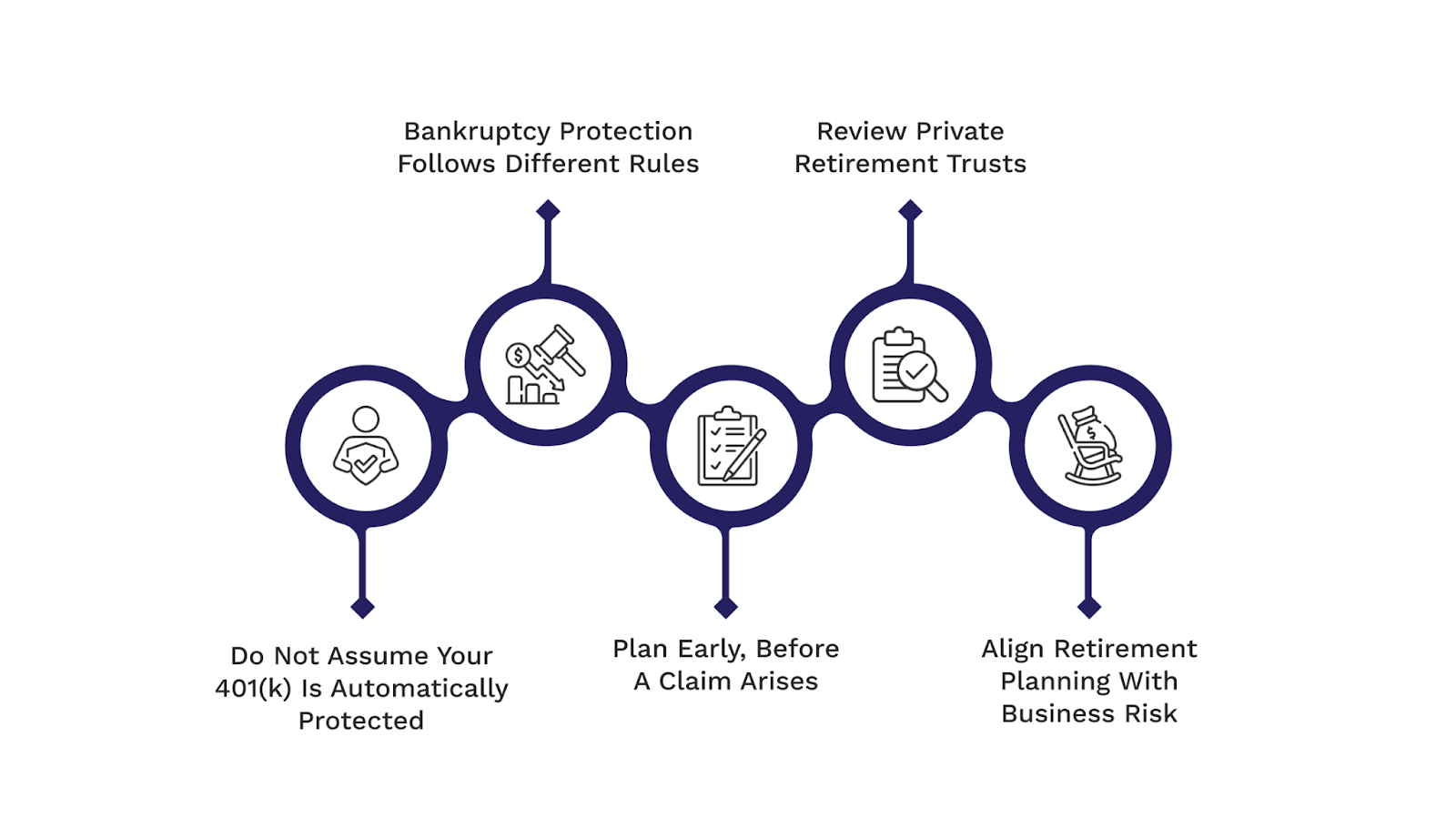
- Do Not Assume Your 401(k) Is Automatically Protected
AB 2837 does not mean your retirement planning is broken. It does mean you should stop relying on old assumptions and start treating retirement accounts like any other asset that may be reviewed in a California state-court collection case.
After AB 2837, a judge may look at what you actually need for retirement and treat any amount viewed as “excess” differently.
- Bankruptcy Protection Follows Different Rules
Bankruptcy protection can still be strong for many employer plans, but it is a separate system with different rules. You should not assume the same protection applies in a non-bankruptcy lawsuit.
- Plan Early, Before A Claim Arises
Early planning matters because your best options usually exist before a claim arises. Once a dispute is underway, changes to ownership, transfers, or restructuring often get more scrutiny and can create additional risk.
- Review Private Retirement Trusts
If you have significant retirement savings, Private Retirement Trusts may be worth reviewing with qualified counsel to confirm they are properly structured and maintained for retirement purposes.
- Align Retirement Planning With Business Risk
Coordination matters. Your retirement planning should align with your business risk strategy and estate plan, so you are not relying on a single account type for protection.
Bring Retirement Planning Into Your Broader Asset Protection Review

AB 2837 represents a fundamental shift in California asset protection law. Retirement accounts that were once completely off limits in state court are now subject to judicial discretion.
For Californians with meaningful retirement savings, this means planning requires more nuance. Bankruptcy still offers robust protection, but outside of bankruptcy, creditors now have a greater ability to challenge the safety of retirement funds.
The best time to address this isn’t after a lawsuit is filed; it’s now, while options still exist and decisions can be made deliberately.
If your estate or asset protection plan relies heavily on retirement accounts, AB 2837 makes this a good time to reassess whether your assumptions still hold. The right strategy depends on how your assets are structured, where potential exposure exists, and how your long-term goals fit together.
Dahl Law Group works with California business owners to evaluate these changes in context, keeping retirement planning, business risk, and estate planning aligned before problems arise.
Frequently Asked Questions
- Are 401(k)s still protected from creditors in California?
Not automatically. Beginning January 1, 2025, California courts must determine how much of a 401(k) is reasonably necessary for retirement. Only that portion is exempt in state court.
- Are IRAs affected by AB 2837?
IRAs were already subject to the “necessary for retirement” test in California. AB 2837 did not change that rule but extended it to employer plans like 401(k)s.
- Does AB 2837 change bankruptcy protection for retirement accounts?
No. ERISA-qualified plans remain fully protected in bankruptcy, and IRAs are protected up to the federal cap.
- Should I move my retirement funds because of AB 2837?
Not automatically. Any changes should be evaluated in light of age, retirement needs, tax considerations, and overall risk exposure, and coordinated with professional advisors.
- Does AB 2837 affect residents of other states?
No. This law applies only to California state court proceedings. Asset protection rules vary significantly by state.

Dahl Law Group
Latest posts by Dahl Law Group (see all)
- How California’s Single-Enterprise Rule Impacts Your Business - April 24, 2026